
Mystery box sites allow users to buy digital boxes and open them for real prizes randomly selected from a list of potential items.
The best mystery box sites list every possible prize and the odds of pulling it, offer to ship physical prizes, and give users the option to exchange them for site credit or crypto at fair prices.
Read on for the full rundown on the main types of mystery box sites, which brands accept US players, how to figure out how much edge you’re giving to the house, and where they stand legally.
Best Mystery Box Sites
Check back soon for our list of featured mystery box apps.
Where to Buy Mystery Boxes Online
Note: What follows is not a recommendation or endorsement of any operator. We will share our recommendations once we've finished reviewing the major mystery box sites and card rip apps.
Mystery Box Site Type Typical Prizes Worth Knowing Underdog Rips Card rips (US company that also runs regulated fantasy and prediction market apps) Graded sports cards Cards auto-sold after 3 days; Underdog buyback offers are set at 100% of fair market value Packz.io Card rips (headquartered in New York City) Sports and trading cards Items auto-sold after 3 days Boxed.gg Card rips (headquartered in Seattle, Washington) Sports cards, trading cards, CS2 skins Free signup prizes locked until you buy 500 gems (about $5) HypeDrop Paid (company registered in Cyprus) Sneakers, streetwear, electronics, collectibles, trips, vehicles, watches Shut down in 2024 and later relaunched Jemlit Paid (company registered in Cyprus) Electronics, gaming, designer goods, watches Payments processed in GBP EmpireDrop Paid (company registered in Hong Kong) Electronics, fashion, watches, luxury goods, cars, gift cards, and more Boxes priced in Euros Upgrader Paid (company registered in Cyprus) Phones, sneakers, watches, gaming gear, and general merch Accepts gift cards and CS2 and Rust skins as deposits. MrLoot Paid (company registered in Cyprus) Trading cards, luxury goods, gaming gear, tech, vacations, Legos, and more Anonymous ownership; limited public track record Cases.gg Sweepstakes (company registered in Cyprus) Electronics, sneakers, watches, trading cards, LEGOs, and more Hand-written mail-in request gets you 5 Cases Cash (not much) Giveaways.com Sweepstakes (LLC registered in Delaware but actual headquarters likely in Cyprus) Electronics, gaming gear, luxury goods, vehicles Sweepstakes casino first; mystery boxes are an add-on
Free Mystery Boxes and Promo Codes
Nearly all mystery box sites offer free boxes to new users as a welcome bonus. Free mystery boxes can be a good deal, but they always come with terms and conditions that cap their value.
Some of the most common caveats include:
- You may not be able to sell or ship a prize from a free online mystery box until you’ve bought site credit.
- You may have to deposit funds before you can open a site’s free mystery boxes.
- Free mystery boxes usually have unique prize lists that look nothing like the list on a $100 box.
How Mystery Box Sites Work
All mystery box sites operate on the same basic premise: you buy virtual boxes for fixed prices, then open them to see which of the potential prizes you’ve won.
Typical online mystery boxes provide a list of potential prizes, each with an estimated value and the odds of pulling that specific item. So, you know what you could win, but you only find out what you’ve actually won after you pay and open the box.
Prize pools are usually tiered, ranging from items worth less than what you paid (the most frequent outcome) to items worth many times what you paid (the rare “big win”).
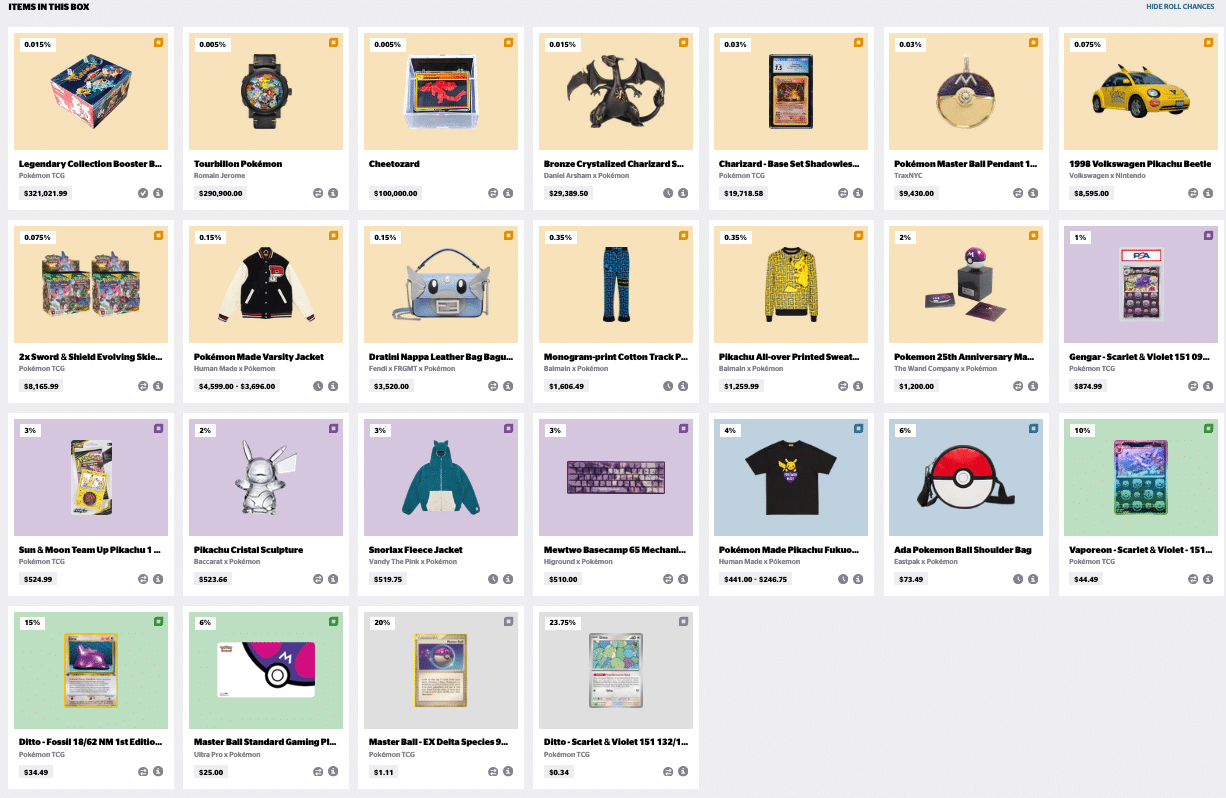
Many mystery boxes have themed prizes (e.g., electronics, trading cards, luxury goods). For example, the prizes inside one site’s “Masterball” box might contain a variety of Pokémon-related merch and cards:
Meanwhile, another site’s “Spoiled Wife” box might contain designer purses and sunglasses, luxury accessories, and high-end jewelry:
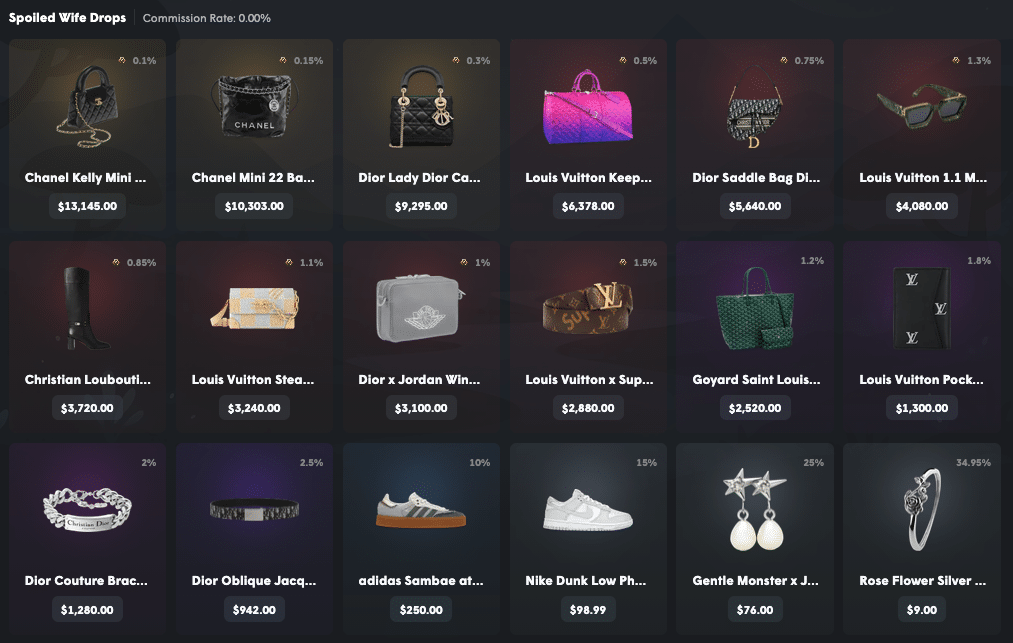
If you know your Pokémon or designer goods prices, you may notice that some of these MSRPs are inflated – more on that below.
Mystery box prices range from under $1 to thousands of dollars, depending on what’s inside and the odds of winning a high-end item.
Types of Mystery Box Sites
Most mystery box sites fit into one of three main categories. They look similar from the outside, but they differ in how you pay, the types of prizes they offer, and what you can do with your winnings:
Paid Mystery Box Sites
You buy site credit and open boxes that typically contain physical goods like luxury watches, sneakers, electronics, and trading cards. Often headquartered offshore.
Mystery box sites focused on physical products are the most common and simplest variant: you deposit money, the site converts it into credit, and you spend the credit on mystery boxes.
Most paid mystery box sites are operated by companies registered overseas (often Cyprus or Belize), sometimes with a Delaware LLC to handle payments.
Sweepstakes Mystery Box Sites
Similar premise as paid mystery box sites except based on the same business model as sweepstakes casinos in an effort to further distance themselves from outright online gambling. See the legal section below for more on why some operators use the sweepstakes model.
The distinguishing feature of sweepstakes mystery box sites is that they offer methods for players to obtain coins (site credit) and open boxes without spending money or depositing funds. Common ways to get free coins include participating in daily promotions and mailing handwritten requests.
Card Rip Sites
You buy and open digital packs that contain one real, physical trading card that you can either sell back to the site, have shipped to your address, or in some cases, trade on the site’s own marketplace.
Card rip sites are the most legally defensible since what they offer isn’t much different than buying packs of trading cards at any retailer. As a result, this is the only category in which some sites are run by mainstream sports betting and DFS operators (e.g., Underdog Rips by Underdog Sports and Instant Rips by Fanatics).
Determining What A Mystery Box Is Worth
Every mystery box has the potential to drop an item worth far more than what you paid, which is the whole appeal. However, the average value over the long term (expected value) is always less than what you pay to open any given mystery box.
The difference between what you pay for a mystery box and its expected value is how operators make a profit, the same way a slot machine’s return-to-player is always less than 100%.
For example, imagine a $20 general merchandise box with four possible prizes:
- $900 Limited-release sneakers: 0.5% chance
- $150 Wireless earbuds: 3% chance
- $40 Hoodie: 16.5% chance
- $1.50 Keychain: 80% chance
You can determine this box’s expected value by multiplying each list value by its odds and adding them up:
- $900 x .005 = $4.50
- $150 x .03 = $4.50
- $40 x .165 = $6.60
- $1.5 x .80 = $1.20
Add those values together, and you get an average box value of $16.80, or about 84% of the $20 you paid.
However, there are two major caveats here:
First, you should account for the haircut you’ll take when selling unwanted prizes back for site credit or crypto. If a site buys items back at 80% of listed prices, the average return on that $20 sneaker box drops from $16.80 to $13.44.
Second, the precision of your EV calculations depends on the accuracy of your input prices. If you take an operator’s listed item values at face value, your calculations will consistently overestimate mystery box EVs.
Are those “$900” sneakers really worth $900? If the best you can sell them for on eBay or StockX is $600, use the lower number to calculate that box’s expected value.
Case in point: In September 2026, we ran the numbers on a $4.99 PlayStation 5 box at one of the larger sites:
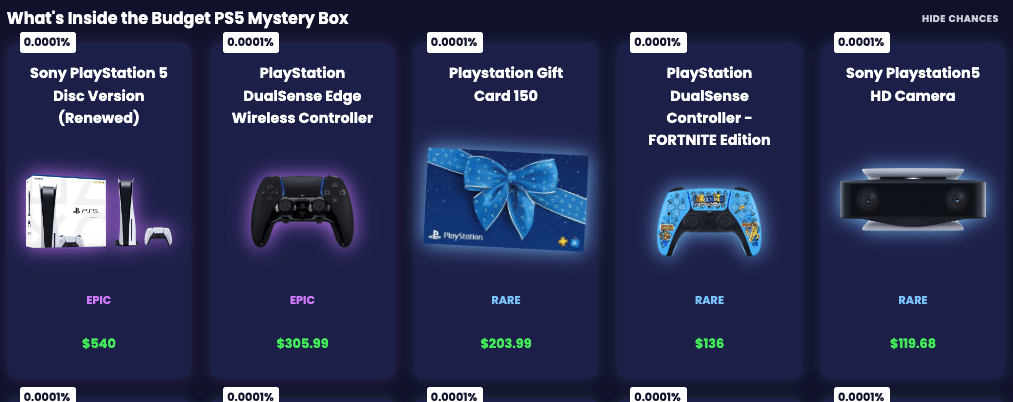
It did contain a PlayStation 5 among its many potential prizes. However, it was a refurbished PS5, valued at $540 with odds of 0.0001% (one ten-thousandth of one percent), or one opening in a million.
The other 35 outcomes were accessories, stickers, and site credit. Based on the site’s own fair market value estimates and odds, this box had an expected value of $3.99, or about 80% of the $4.99 price.
Mystery Box Battles and Games
Most mystery box sites also offer games and contests as an additional option for any prizes you’re not planning to ship, cash out, or sell back.
Some games directly involve the items you’ve won, while others are just straight-up casino games that use your site credit balance:
- Battles: Two or more players take turns opening a predetermined number of mystery boxes. In each round, all players open identical boxes, and each player’s prize value goes toward their scorecard. Whoever finishes with the highest total usually takes every item opened, including everyone else’s. Some sites tweak the rules or fill empty seats with bots, so read the rules before you play.
- Deals: Pick one specific item you want and decide how much to stake on it. Your odds of pulling that item scale with the amount you choose to risk. Imagine a deal for an item worth $100: risking $10 on that deal might give you just under a 10% chance to get it, while risking $50 will get you just under a 50% chance.
- Vending Machines: Some card rip sites offer virtual vending machines stocked with real cards. Each play costs a fixed price and gives you one card at random from whatever’s left.
- Casino-Style Games: Play games like Keno, Crash, Mines, and Plinko using your site credit balance.
What to Watch Out For with Mystery Box Sites
Mystery box sites are unregulated in the United States, which means you have little-to-no recourse if a shipment never arrives or an operator closes your account with money still in it. As a result, it’s critical to choose legitimate mystery box sites with established track records.
The absence of regulation also means operators (generally speaking) are more comfortable burying hidden gotchas in their terms and conditions. Some of the most common terms to look out for include:
- Closed-loop deposits: Most mystery box sites operate as closed-loop virtual economies. That means funds you deposit become non-withdrawable site credit. Similarly, sellback credits usually can’t leave the site, so a $10 sell-back is really a $10 voucher for more mystery boxes. The only way to get value that can exit the platform is to redeem your items for crypto or have them shipped.
- Deadlines and expiration dates: Prizes usually have claim deadlines, site credit expires, and some mystery box sites charge a monthly fee on idle accounts.
- Shipping isn’t guaranteed: Most mystery box sites do not store every possible prize in a large warehouse, so sourcing often happens after a win. If an operator cannot deliver an out-of-stock item, it may reserve the right to credit you with site credit instead (a terrible outcome if you win something worth a lot of money) or offer an exchange. If you’re hunting big wins, make sure to read the site’s shipping/out-of-stock policies first.
Are Mystery Box Sites Legal?
The legality of mystery box sites is unsettled.
No state explicitly bans mystery box sites, but that doesn’t make them immune to existing gambling laws. To date, no court anywhere in the US has ruled on whether mystery box sites qualify as illegal gambling.
The legal uncertainty explains why the list of restricted states can vary from one mystery box site to the next. In the absence of clear legal guidance, each operator decides on its own which states it serves based on its read of local gambling laws and risk tolerance.
Why They Sit In A Legal Gray Area
Most state statutes apply the “three elements” rule to determine if an activity qualifies as illegal gambling:
- Consideration (you pay to participate)
- Chance (random outcomes)
- Prize (you stand to win something of value)
On paper, mystery box sites check all three boxes. However, operators have devised two legal defenses.
Paid mystery box sites contend that because every box contains an item, you’re buying a product with a random pick, which makes them more like a pack of baseball cards than a slot machine.
Mystery box sites that operate on the sweepstakes model go after the element of consideration instead. They contend that because there are ways to get site credit for free (via mail-in requests and other promotions), nobody has to pay to participate.
Despite those workarounds, the legal uncertainty persists because neither defense has been tested in court.
Why Most Mystery Box Sites Block Washington
Nearly all mystery box sites block Washington because existing law and precedent established in rulings involving similar business models make it a particularly high-risk state from a legal perspective.
Washington law defines a “thing of value” broadly enough to include virtual credits and virtual prizes. In 2018, the Ninth Circuit applied that definition to Big Fish Casino’s chips and ruled that its games constituted illegal gambling in Washington.
Additionally, state law allows players to sue operators to recover money lost at illegal gambling. That’s why the Big Fish Casino case ended in a $155 million settlement.
The combination of the state’s broad gambling laws, loss-recovery statute, and established precedent is what keeps most operators out of Washington.
Do Sweepstakes Casino Bans Cover Mystery Box Sites?
The answer depends on whether a sweepstakes-based mystery box site also offers casino-style games.
Numerous states have banned sweepstakes casinos since 2025. Those laws cover any sweepstakes site with slots or casino-style games in the lobby, boxes or no boxes.
Box-only sweepstakes sites interpret the laws as aimed at casino-style games rather than mystery boxes. However, no regulator or court in any state with a sweepstakes ban has stated whether their laws apply to box-only sweepstakes sites.
The Bottom Line for Players
So far, the legal questions and risks concern operators more than players. The bigger risk for players is the absence of state oversight. If a mystery box site fails to ship an item, or you have a dispute with an operator, there’s no independent regulator to turn to for assistance.
That said, we’re not lawyers, and this is not legal advice. If you have any concerns regarding the legality of buying mystery boxes online, your best bet is to speak with a qualified professional.
Responsible Play with Mystery Boxes
Mystery box sites may not meet the legal definition of gambling, but anything that combines risking money on uncertain outcomes with the allure of large prizes has the potential to cause problems.
Therefore, we recommend treating mystery boxes the same way you’d treat any regular bet: consider any money you deposit as “already spent” and plan accordingly.
In other words, don’t risk money you can’t afford to lose. If it would sting to spend X amount on opening a box, that’s a sign you need to look for cheaper boxes if not stop altogether.
The mystery box format makes responsible play harder than it sounds because boxes open in seconds, instant sellbacks for site credit keep the same money cycling, and sessions have no clear endpoint unless you set one yourself.
State-administered self-exclusion programs don’t cover mystery box sites, so use each operator’s own deposit limits and self-exclusion tools if they’re available. Third-party blockers like Gamban and BetBlocker can block access to mystery sites that don’t offer self-exclusion.
If you find yourself chasing losses, spending more than feels comfortable, or feeling concerned about your play for any reason, the National Council on Problem Gambling offers free, confidential help 24/7. You can call their nationwide helpline at 1-800-MY-RESET or text 800GAM.
See our responsible gambling guide for more information, warning signs, and additional ways to get help.
Mystery Box Sites FAQ

Wes Burns has more than a decade's worth of experience as a writer, researcher and analyst in the legal gambling industry and is co-founder of BettingUSA.com. As a former professional online poker player, Wes approaches his work from the viewpoint of players.