
How trading at Robinhood works
Robinhood is a prediction market site that allows you to forecast outcomes of real-world events. To predict an outcome, you will buy event contracts. These contracts are attached to Yes and No outcomes. So, if you believe an outcome will happen, you would buy the Yes contract. If you predict that the outcome will not happen, then you buy the No contract.
All event contracts range between $0.01 and $0.99. The price also reflects the implied probability. For example, if you buy a Yes contract for $0.66, then this represents roughly a 66% chance of that outcome happening. If your prediction is correct, you then get a $1 settlement. Otherwise, if your forecast is wrong, your contract settles at $0.
This is then where the fees come into action. To calculate your total profit, you will need to deduct the fees you paid. So, if you bought a Yes contract for $0.66 and got a $1 settlement for being correct, your profit isn’t $0.34. To get your true profit, you will need to remove the total amount of fees. Keep reading to learn more about how to do this.
Robinhood’s fee structure
As of June 1, 2026, Robinhood rolled out a fresh trading fee structure. Previously, the operator applied a flat rate to all event contracts. These days, it works on a probability-based calculation. Despite that, you can expect a commission fee of $0.01 and an exchange fee of $0.01 per contract, on average. Of course, these fees are variable, but these are the maximum fees you will encounter.
Ultimately, the fees you pay will depend on your tier-based constant, contract price, and number of contracts you have traded. In this context, a tier-based constant is variable depending on whether you have a Robinhood Gold subscription or not. For example, if you do have a Gold subscription, then it’s 5%. On the other hand, if you don’t, then it’s 10%.
Calculating your commission fee
Robinhood has shared the formula that’s used to work out the commission fee, which is: (k * p * (1 − p) * c). To give you a better understanding of what this means, here’s a clearer explanation:
| K | Tier-based constant |
| P | Contract price, represented as a decimal between 0 and 1 |
| C | Number of contracts |
What to expect your commission fee to be
The commission fees are always at their lowest with high-conviction prices, which are near $0 or $1. On the other hand, commission fees are highest when near $0.50. Regardless, the commission fees are always rounded up to the nearest $0.01 on all event contracts. There is a maximum commission fee of $0.01 per contract, so you will never pay any more than this.
Using 100 event contracts as an example, here’s an overview of what your commission fees would be with and without a Gold subscription:
| Contract Price | With Gold Subscription | Without Gold Subscription |
|---|---|---|
| $0.01 | $0.05 | $0.10 |
| $0.05 | $0.24 | $0.48 |
| $0.10 | $0.45 | $0.90 |
| $0.15 | $0.64 | $1 |
| $0.20 | $0.80 | $1 |
| $0.25 | $0.94 | $1 |
| $0.28-$0.72 | $1 | $1 |
| $0.75 | $0.94 | $1 |
| $0.80 | $0.80 | $1 |
| $0.85 | $0.64 | $1 |
| $0.90 | $0.45 | $0.90 |
| $0.95 | $0.24 | $0.48 |
| $0.99 | $0.05 | $0.10 |
Exchanges will incur an additional fee
The exchange fee is applied to both opening and closing trades. The good news is that while the exchange fee is variable, it will be up to $0.01 per contract. Combined with the commission fee, you will only pay up to $0.02 in total.
 Welcome to Robinhood prediction markets site
 Trade with low commission fees
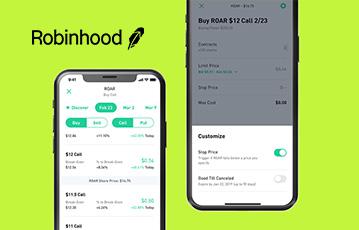 Buy event contracts while out and about
An example of Robinhood’s fees
Now that you know more about the commission and exchange rates, it’s time to walk you through exactly how this will work in practice. To give you an idea, this example will be based on you buying 100 event contracts.
- You buy 100 Yes contracts at the price of $0.80 each.
- The exchange fee is $0.01 per contract.
- You have a Gold subscription, so the commission is $0.80.
- The commission formula is: (5% * $0.80 * (1 − $0.80) * 100)
- The total you will pay in fees is $81.80.
Now, let’s say that you do not have a Gold subscription. Using the above example, your fees will change to $82.60.
Robinhood may apply a fee to your payments
In addition to the commission and exchange rates, you will also need to consider potential transaction fees. The great news is that deposits do not generally incur a fee. Just like when searching for Polymarket fees, no page was left untouched on Robinhood. There was no mention of any deposit fees on the payment information pages, so it appears that deposits are completely fee-free.
While deposits do not have a fee attached, you should weigh up the processing time. The speed of your deposit will vary depending on the method you choose, which goes as follows:
| Deposit Method | Processing Speed |
|---|---|
| ACH | Up to 5 business days, but you may have access to a portion instantly |
| Debit Card | Within 30 minutes |
| Instant Bank Transfer | A few minutes |
| Internal Transfer from your Robinhood Banking account | Instant |
That said, there are withdrawal fees to keep in mind, depending on the payout method you use. If you choose ACH, then there is no fee attached to your withdrawal. On Robinhood, ACH is often referred to as a standard bank transfer. So, if you spot any references to a standard bank transfer, this is what’s being discussed. The other withdrawal options are debit cards and instant withdrawals direct to your bank. Both of these methods incur a 1.75% fee, as well as having limits of $1-$150 per withdrawal.
Are there any more fees attached to trading at Robinhood?
You have now learned all there is to know about the direct fees from Robinhood. The only other thing you will need to keep in mind is that you will need to pay taxes if you get settlements from correct predictions. If you receive any money from Robinhood as part of your trading, then it should be reported as part of your normal annual tax return. However, you may not meet the thresholds for paying tax on any settlements. That said, you will need to keep track of the total amount of funds you receive from Robinhood to make sure.
What else to check before opening an account at Robinhood
You should always read about the fees before you join a new prediction market site. Now that you have done this, it’s time to take a peek at other factors you should consider. Here are some of the other things you should keep in mind and tick off before deciding to join Robinhood:
- You need to be at least 18 years old to create an account.
- Some US states may require you to be 21+ years old.
- Your age, identity, and location will be verified through the KYC (Know Your Customer) checks.
- Robinhood is federally regulated by the CFTC, but you should check its availability in your area before you proceed.
- Find out if there’s a bonus available for you to claim.
- If you have a Robinhood referral code, make sure you enter it to claim any attached offers.
Pros and cons of the fees at Robinhood
Like most other prediction market sites, Robinhood has a fee structure. After all, that’s how Robinhood makes money. As you can see, the fees are transparent and shared upfront, so there are no surprises later on. You can learn all about the fees before you even create an account, which is great to see. Despite the upsides, there are some downsides, too. Let’s look a little closer at the main pros and cons right here:
Pros
Easy formula to use Reasonable fees Fees are capped Fee-free depositsCons
Fees apply to all tradesConclusion: You should learn about Robinhood fees before you trade
From the moment you open an account at Robinhood, you should start reading about the fees. Fees are applied to all event contracts, so it’s a big part of your trading experience. Without knowing how the fee structure works, you will not know what to expect. The good news here is that the commission and exchange fees are capped at $0.02 per contract. This means that you will never pay more than $0.02, but you can pay less.
You should also note that withdrawals may be subject to a fee, depending on your preferred payment method. There are fee-free withdrawal methods available, so this is worth considering if you are flexible. Ultimately, why not avoid another fee if you can?
Many traders will appreciate the upfront approach to the fees. In fact, Robinhood has multiple resources and FAQs on the website, so you can find out all about the fees before you join. This makes your life so much easier. If you also like Robinhood’s approach and want to start trading, all you need to do is click the promotional banners on this page. You can then create an account yourself to start testing the waters.
Robinhood fees FAQs

Wes Burns has more than a decade's worth of experience as a writer, researcher and analyst in the legal gambling industry and is co-founder of BettingUSA.com. As a former professional online poker player, Wes approaches his work from the viewpoint of players.