
Crypto prediction markets allow users to trade yes/no contracts on future cryptocurrency prices and related news developments.
You don’t need a crypto wallet, a Coinbase account, or any Bitcoin to trade crypto prediction markets. What you need is a funded account on a regulated prediction market platform and an opinion about where prices are going or how events will unfold.
Typical cryptocurrency prediction markets ask questions like:
- “BTC up or down in 15 minutes?”
- “Will XRP exceed $X price in February?”
- “Will Satoshi move any Bitcoin this year?”
Continue below for a comprehensive guide to how cryptocurrency prediction markets work. We’ll explain where to bet on Bitcoin prices, outline the different types of crypto markets, and discuss the strategy considerations that are unique to crypto predictions.
If you’re new to prediction markets entirely, see our prediction markets guide for the basics of how event contracts work, how order books function, and the legal landscape before you dive in here.
Legal Crypto Betting Sites
 Play $5 Get $75 In Fantasy EntriesUnderdog Predict Promo Code: BETUSA
Prediction Event Contracts is a derivatives product offered by Crypto.com | Derivatives North America (CDNA), an exchange regulated by the Commodity Futures Trading Commission (CFTC). Trading CDNA Prediction Event Contracts involves risk and may not be appropriate for all. By trading you risk losing your cost to enter any transaction, including fees. You should carefully consider whether trading on CDNA is appropriate for you in light of your investment experience and financial resources. Any trading decisions you make are solely your responsibility and at your own risk.
Play $5 Get $75 In Fantasy EntriesUnderdog Predict Promo Code: BETUSA
Prediction Event Contracts is a derivatives product offered by Crypto.com | Derivatives North America (CDNA), an exchange regulated by the Commodity Futures Trading Commission (CFTC). Trading CDNA Prediction Event Contracts involves risk and may not be appropriate for all. By trading you risk losing your cost to enter any transaction, including fees. You should carefully consider whether trading on CDNA is appropriate for you in light of your investment experience and financial resources. Any trading decisions you make are solely your responsibility and at your own risk.
 $10 Welcome Bonus
18+ to play. T&Cs, restrictions, and exclusions apply.
$10 Welcome Bonus
18+ to play. T&Cs, restrictions, and exclusions apply.
 Up To 1 Bitcoin in CROCrypto.com Promo Code: None needed.
18+ to trade. T&Cs, restrictions, and exclusions apply. Please trade responsibly.
Up To 1 Bitcoin in CROCrypto.com Promo Code: None needed.
18+ to trade. T&Cs, restrictions, and exclusions apply. Please trade responsibly.
 Trade $20, Get $20
Prediction is an event contract that is a derivatives product offered by Crypto.com | Derivatives North America (CDNA), a CFTC-regulated exchange through OG technology. Trading on CDNA involves risk and may not be appropriate for all. By trading you risk losing your cost to enter any transaction, including fees. You should carefully consider whether trading on CDNA is appropriate for you in light of your investment experience and financial resources. Any trading decisions you make are solely your responsibility and at your own risk.
Trade $20, Get $20
Prediction is an event contract that is a derivatives product offered by Crypto.com | Derivatives North America (CDNA), a CFTC-regulated exchange through OG technology. Trading on CDNA involves risk and may not be appropriate for all. By trading you risk losing your cost to enter any transaction, including fees. You should carefully consider whether trading on CDNA is appropriate for you in light of your investment experience and financial resources. Any trading decisions you make are solely your responsibility and at your own risk.
Crypto Prediction Market Apps
Despite the rapid-fire launches of new prediction market platforms since the CFTC dropped its appeal against Kalshi in May 2025, only a few offer extensive crypto markets.
Kalshi is the current US-regulated leader in this space, although it faces increasing pressure from Polymarket, which has only recently begun ramping up its US expansion efforts.
Here’s a look at the best crypto prediction markets, starting with a high-level overview and followed by closer looks at each of the major players:
| Platform | Strengths | Funding Options | Limitations |
| Kalshi | Daily/intraday prices; 15-minute directionals; high liquidity | Debit card, Apple Pay, bank transfer, crypto, wire | Fewer project-specific markets; limited altcoin coverage |
| Polymarket US | Daily/intraday prices; 5-minute directionals; altcoins and projects | Debit card, bank transfer, crypto | Less liquidity, still ramping up its US operations |
| Coinbase | Access to all Kalshi markets from within the Coinbase app – convenient for existing Coinbase users | Debit card, Apple Pay, bank transfer, crypto, wire, PayPal, Coinbase gift card | Coinbase charges Kalshi’s trading fees + a small markup |
Kalshi Crypto Markets
Kalshi is the deepest regulated platform for crypto prediction markets in the US. Kalshi covers Bitcoin, Ethereum, Solana, and XRP across multiple market formats:
- Intraday ranges
- Daily price ranges
- Weekly ranges
- 15-minute up/down markets
Market depth and liquidity on BTC and ETH intraday range markets is generally solid during US trading hours. The 15-minute products are newer, so liquidity varies by time of day.
Kalshi’s fee structure for these contracts follows its standard formula-based model, which scales with contract price and position size. For short-duration contracts where you’re in and out quickly, calculate fees as part of your expected return before entering.
Kalshi also lists milestone-type markets (“How high will Bitcoin get this year?”) and periodic coverage of protocol events when trading interest warrants it.
Coinbase Crypto Markets
Coinbase Predict (integrated into the existing Coinbase app and website) offers prediction markets through a partnership with Kalshi.
Every crypto market available on Kalshi is accessible through Coinbase Predict. That includes the same intraday, 15-minute directional, and milestone markets, all with the same resolution flows and liquidity as with Kalshi.
Coinbase Predict offers one practical advantage compared to going straight to Kalshi: convenience. If you’re already a Coinbase customer, there’s no new account to open, no additional KYC, and no separate funding step. Your existing USD or USDC balance works directly.
For crypto traders who spend significant time on Coinbase and want to trade prediction markets without switching platforms, the convenience is a major selling point.
However, the trade-off is fees. Coinbase Predict applies a markup on top of Kalshi’s base fee formula (and clearly lists the fee on the order screen before confirmation), but it does not disclose exactly how it calculates the fee.
In our own testing, a 10-contract order that cost $0.16 in fees on Kalshi generated $0.20 in fees on Coinbase Predict – roughly 25% higher for the same trade. The absolute difference on small orders is negligible, but active traders should factor this in when deciding whether the convenience is worth the higher fees.
Polymarket Crypto Markets
Polymarket was geofenced for several years from US users following a 2022 Commodity Futures Trading Commission (CFTC) enforcement action. That changed in late 2025, when Polymarket acquired a CFTC-registered derivatives exchange, received an Amended Order of Designation in November 2025, and announced its imminent relaunch in the USA.
The current US access model is different from the old wallet-connect approach. Now, US traders use regulated funding methods and undergo full KYC (identity verification) when opening accounts. Polymarket’s global version, which still operates on-chain via USDC on Polygon, remains off-limits to US residents.
Polymarket has historically had the deepest market coverage on altcoins, protocol events, and longer-duration crypto milestones. Whether that depth and liquidity transfers fully to the US version is yet to be determined.
Other Regulated US Platforms
Other CFTC-regulated platforms offer fewer crypto and bitcoin prediction markets than the Big Three (Kalshi, Coinbase, and Polymarket).
Despite its name, Crypto.com does not offer many crypto prediction markets. That may change over time, but its prediction markets are just one part of Crypto.com’s expansive and well-established business model.
Similarly, prediction markets attached to online sportsbooks provided few or no crypto coverage. Platforms like FanDuel Predicts, Fanatics Markets, and DraftKings Predictions primarily focus on sports, politics, and economics markets. Currently, their crypto prediction markets remain primarily limited to once-a-day Bitcoin or Ethereum prices.
If crypto markets are your primary focus, Kalshi, Coinbase, and Polymarket should be your first choices.
What Makes Crypto Markets Different
Most non-crypto prediction market categories share a common limitation: their outcomes play out slowly and infrequently.
An election result comes in on one night. An economic indicator goes out once a month. Even sports event contracts move slowly compared to crypto and Bitcoin prediction markets.
Crypto prediction markets are different in four primary ways:
24/7 Information Flow and Resolutions
Prices update continuously, 24 hours a day, seven days a week on exchanges that publish verifiable, timestamped data. That creates something unusual in the prediction market world: a category where intraday, hourly, and even 15-minute markets are feasible and highly liquid.
Unambiguous, Instant, & Verifiable Outcomes
Crypto markets based on pricing data rarely settle with ambiguous outcomes: the underlying cryptocurrency either hits the range/target price or it doesn’t, and everyone can verify it independently.
Consistent Volatility
That continuous data flow also means the market reprices extremely quickly. A single piece of macro news (e.g., an inflation print, a Fed comment, or a regulatory headline) can shift BTC’s price by several percentage points in minutes. Prediction market contracts will reprice accordingly, and fast.
Traders accustomed to the slower cadence of political or economic markets will find crypto markets noticeably more reactive.
Unique, Domain-Specific Subcategories
Crypto markets come in more distinct “shapes” than most categories: ultra-short directional markets, intraday levels, end-of-day ranges, longer-horizon “milestone” questions, and (especially on crypto-native platforms) protocol or ecosystem event questions that don’t exist anywhere else.
Questions like “Will X Project deploy on mainnet by Y Date?” or “Will Solana be above $X on February 19th?” are native to the crypto space. They require knowledge that only participants in that ecosystem are likely to have, which creates real information asymmetry – the foundation of a tradable market.
Types of Crypto Prediction Markets
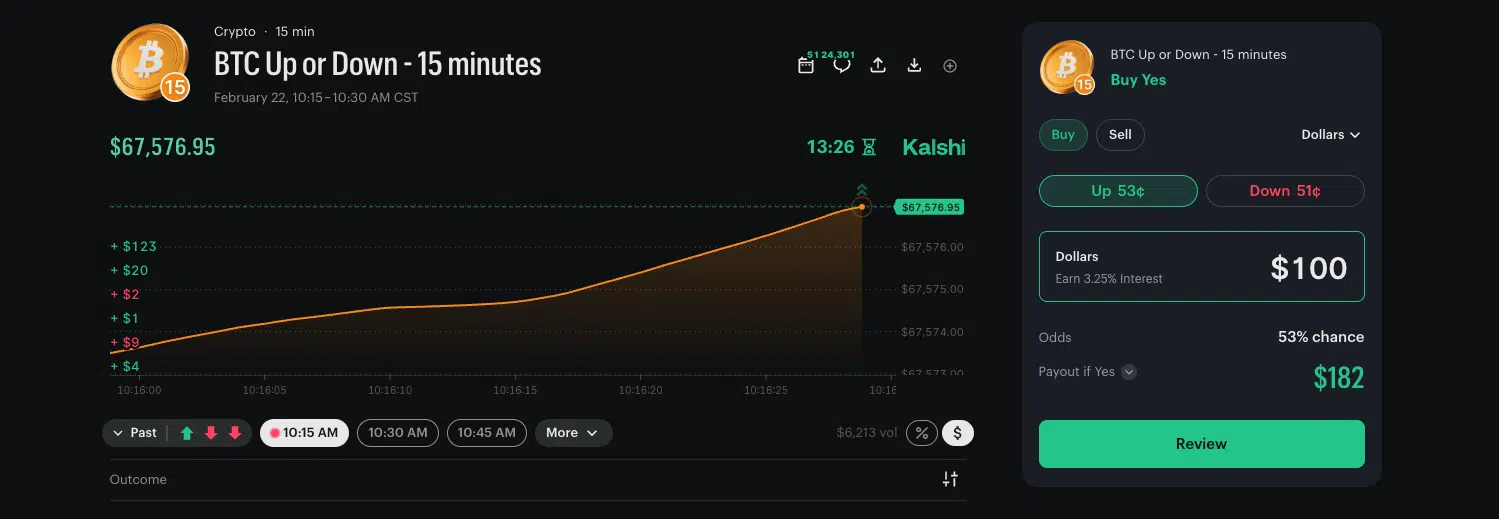
The crypto category on regulated prediction market platforms generally breaks into four distinct market formats. Each has its own structure, risk profile, and strategic implications.
Intraday Crypto Price Range Markets
These are the workhorses of the crypto prediction market category. A typical example: “Bitcoin price range today at 5 pm EST?” Kalshi lists intraday markets for BTC, ETH, SOL, and XRP, each structured as a series of price range brackets. Each bracket is its own yes/no contract.
For instance, a BTC intraday range market might offer brackets like:
- $92,000–$92,499
- $92,500–$92,999
- $93,000–$93,499
- $93,500 or above
You buy Yes contracts on the bracket you think will contain BTC’s price at the designated settlement time. Only one bracket resolves at $1; all others expire at $0.
The settlement time matters enormously. These markets typically resolve against a specific price feed at a specific time, like 5 pm EST sharp. A price that spends most of the day in your bracket but blips up or down at 4:58 pm can still resolve against you.
Understanding the exact resolution methodology for each market (which price source, which timestamp) is not optional. It’s the difference between a correct analysis and a losing trade.
Directional Short-Term Crypto Markets
Fifteen-minute crypto price markets pose a simple question: “BTC Up or Down in 15 minutes?”
For example, if you think the price will be higher 15 minutes from now, you can buy Yes contracts on “Up.” If the price at the end of the 15-minute window is higher than it was at the start, your contracts resolve at $1 each.
This format has obvious parallels to binary options, and Kalshi’s Head of Crypto has acknowledged the similarity directly. The critical difference is that these are exchange-traded contracts with public order books, regulated by the CFTC, and subject to defined resolution rules published in advance. Traditional retail binary options, which were banned in the UK for retail customers and have a troubled regulatory history in the US, were frequently offered by unregulated offshore operators with opaque pricing.
The short time horizon in 15-minute up/down markets creates real cost-of-trading issues worth understanding before jumping in – more on that in the strategy section.
Price Milestone Markets
Crypto price milestone markets take a longer view: “Will Bitcoin hit $150,000 by the end of the year?” or “How high will XRP get in February?” Rather than a precise settlement price at a precise moment, milestone markets are structured around a threshold. If BTC touches $150k at any point during the defined window, Yes contracts resolve at $1.
Price milestone markets tend to have lower implied probabilities for ambitious targets, which means Yes contracts are cheap, but cheap contracts can still be mispriced. A Yes contract priced at $0.08 implies 8% odds. Whether that’s accurate depends on how you model BTC’s distribution of outcomes over the relevant timeframe.
Liquidity in milestone markets is generally thinner than in intraday range markets, particularly for longer time horizons and less-traded assets. Wide bid-ask spreads are common. Limit orders are often more practical here than market orders.
Blockchain Protocols & Pre-Market Projects
Protocols and projects are the most crypto-native formats and have the highest potential information asymmetry (read: an edge for informed traders to exploit). Markets in this category ask questions like:
- “Will GTE deploy on MegaETH mainnet day 1?”
- “Will X token be listed on Y exchange by Z date?”
- “Will Solana ship feature X by date Y?”
Traders familiar with a project’s development timeline, team capacity, or community dynamics have a legitimate information edge in these markets. That’s actually the point: prediction markets are designed to uncover distributed, specialized knowledge.
If you closely follow news and updates involving blockchain protocols, specific cryptocurrencies, and related projects, these markets may be where you have the most monetizable expertise.
The trade-off is liquidity. Protocol markets on smaller projects can be very thin. Entering a large position may move the contract price significantly, and exiting before resolution can be difficult if no counterparty is available.
How Crypto Prediction Markets Work
Contract prices in crypto prediction markets behave differently from those in slower-moving markets, and it’s worth understanding why before trading.
On any prediction market, the Yes contract price reflects the market’s collective estimate of the probability that the outcome will occur. A Yes contract at $0.62 implies a 62% probability. That much is standard.
In crypto markets, the speed of price movement creates a specific dynamic: implied probabilities on intraday range markets can shift dramatically within minutes. If BTC is at $92,400 and you’re holding Yes on the “$92,000–$92,499” bracket with an hour to settlement, your contract might be at $0.75. If BTC suddenly moves to $93,200, that same contract could drop to $0.08 within seconds.
That kind of price action is normal and not a malfunction. It’s the market repricing an outcome that just became much less likely. But it can catch you off guard if you’re used to sports or political markets. In those categories, prices update gradually over hours or days. In crypto, they update in real time.
Here are a few price-related points worth noting:
- The bid-ask spread in crypto markets, particularly short-duration markets, is often wider as a percentage of potential profit than in other categories. On a Yes contract priced at $0.10, a spread of $0.02 represents a 20% round-trip cost before you’ve made any money.
- Each market’s rules section specifies the resolution source. For example, some exchanges use their own internally calculated index prices, referencing multiple exchange feeds.
- The exact methodology matters if you’re trading near the settlement boundary. A $100 price discrepancy between exchanges can determine whether a range bracket hits or misses. Read the resolution rules for any market you trade.
- Liquidity varies significantly by asset. BTC and ETH intraday markets tend to have the deepest order books. SOL and XRP markets are significantly thinner. Protocol and ecosystem markets for smaller projects can be extremely shallow.
Crypto Prediction Strategy Considerations
Note: Nothing here should be interpreted as trading advice. These are general observations about how crypto prediction markets differ from other categories.
Volatility Cuts Both Ways
Crypto’s volatility can work for or against you, depending on position and timing. A BTC range market that looks likely to resolve in your favor can reverse in minutes. That speed creates opportunities when the market hasn’t yet absorbed new information, but it also means the cost of being wrong rises quickly.
Liquidity Gives Weight to Prices
Crypto markets can look extremely efficient when they’re deep or like pure noise when the book is thin.
In a thin market, the displayed price can move significantly with small orders and doesn’t necessarily represent a stable consensus. In a deeper market, you’ll often see smoother repricing and more reliable “wisdom of crowds” behavior.
If you’re using the price as an information tool (“what’s the crowd probability of BTC closing above X?”), you want the markets where price changes are supported by meaningful volume and depth, not just a few small trades.
Mind Your Fees & Spreads in Short-Term Markets
Fifteen-minute crypto markets are fun, but fees and spreads compound quickly if you’re executing frequent trades.
In a 15-minute contract, the maximum upside from buying at $0.40 is $0.60 (because it settles at $1 if you’re right). If the bid-ask spread is $0.06 wide, you’re paying a big fraction of your potential upside just to enter, before accounting for fees or even knowing whether you’re right.
Fees also impact your upside, regardless of the spread. For example, Kalshi applies a formula-derived fee to each contract you buy or sell. Fees accumulate quickly when you’re entering and exiting several positions per hour in 15-minute Bitcoin prediction markets.
Fifteen-minute markets make it easy to stack small negative edges (spread + fees + bad entries) into a meaningful drawdown.
Put another way: short-duration markets reward discipline and punish overtrading.
Spreads and fees are why many experienced traders treat ultra-short markets as an execution game: entry price, exit price, and timing matter at least as much as direction.
If you want to participate without turning it into a slot machine:
- Decide your maximum number of trades per session before you start
- Size down relative to what you think you “could” do
- Track your fill prices and spreads like a real cost, not an afterthought
Longer-Term Markets Reward Patience & Calibration
“Will Bitcoin hit $200,000 by December 31st?” is a fundamentally different analytical problem than a 15-minute directional trade. Longer-term contracts reward analytical probability assessment, emotional control, and a willingness to adjust as new information arrives.
If you have a disciplined view on BTC’s price distribution over a multi-month horizon, and the market’s implied probability diverges from yours, there’s a real edge to be had. If you’re just guessing, you’re paying fees to find out.
Protocol Markets Reward Research
Protocol markets are specialist territory. They reward traders who are willing to conduct broader and more in-depth research than other market participants.
For example, if you follow a specific blockchain project, you can check market prices against primary sources like:
- The project’s GitHub commit history
- Developer Discord updates
- Token unlock schedules from sources like Dune Analytics and TokenUnlocks
- Official roadmap documentation
A market asking whether a mainnet deployment will happen by a specific date is directly resolvable against public on-chain data. That’s the information edge (not intuition) that most participants don’t have.
Plan Your Exits
Resolution timing is a variable, not a technicality. Do not underestimate the importance of planning your exits (and sticking to them) when developing your crypto trading strategies.
In intraday range markets, contracts resolve at a specific moment. A position that looks secure with 30 minutes to go can turn entirely on a single large trade on a major exchange.
Some traders exit winning positions early to lock in gains rather than holding to resolution. The math isn’t always favorable (e.g., you sell at $0.88 when you might have collected $1.00), but eliminating resolution-moment volatility provides real value on high-confidence positions.
Decentralized Prediction Markets
In addition to the regulated platforms discussed above, there is a parallel world of decentralized prediction markets (DPMs) that operate on blockchain networks without a central authority.
The most prominent DPM is Polymarket’s global version (an entirely separate entity than its CFTC-regulated US exchange). Additional, less-prominent DPMs have launched on Solana and other networks in the years since Polymarket debuted.
Decentralized prediction markets offer a few advantages over their regulated counterparts, including lower platform fees, no KYC identity verification requirements (in most cases), and a broader range of crypto-related markets. However, DPMs also come with significant downsides worth knowing before diving in.
Visit our full DPMs guide below for a detailed explainer of how they work, their advantages, disadvantages, and more:
Legal Considerations
Note: See our main prediction markets guide for a more detailed discussion of the legal landscape for prediction markets in general. Below, we’ll address a few points that are specific to the crypto category.
The CFTC’s jurisdiction over crypto markets is actually more established than its jurisdiction over political prediction markets and sports event trading.
Most importantly, the CFTC has long regulated Bitcoin and Ether derivatives under the Commodity Exchange Act, treating them as commodities. Crypto prediction markets on CFTC-registered platforms sit within a framework the agency is familiar with.
Decentralized prediction markets (DPMs) have different legal implications. For example, the lack of KYC identity checks at DPMs likely conflicts with the CFTC’s existing registration requirements, regardless of the platform’s decentralized model.
The CFTC has pursued enforcement against DPMs before, and Polymarket’s 2022 settlement is the most prominent example. That risk doesn’t disappear because a platform lacks a central operator.
State-level challenges to prediction markets are ongoing and largely focus on sports and political contracts, but they impact CFTC-regulated platforms broadly. The federal framework is stable, but the state-level situation remains fluid.
Crypto Prediction Markets FAQ

Wes Burns has more than a decade’s worth of experience as a writer, researcher and analyst in the legal gambling industry and is co-founder of BettingUSA.com. As a former professional online poker player, Wes approaches his work from the viewpoint of players.