
Prediction markets let you trade on the outcomes of real-world events in a vast range of categories, ranging from sports and elections to weather and economic indicators.
In short, you buy and sell “yes” or “no” contracts on questions like “Will the Cowboys win on Sunday” and “Will Candidate X win the next US Presidential Election.”
Critically, prediction markets are regulated by the Commodity Futures Trading Commission (CFTC) as financial services and are available nearly nationwide However, several states restrict event contracts based on sporting events (more on that below).
Quick Start Guide: The Basics
Where to Trade
Several CFTC-registered prediction markets operate in the US:
-Kalshi
-Crypto.com
-Polymarket
-PredictIt
-Robinhood
How It Works
-Market asks a question:
-“Will X happen by next month?”
-You buy Yes or No contracts
-Each pays $1 if correct, $0 if not.
-Example: You buy Yes at 62¢ and receive $1 if correct (profit: 38¢ per contract)
Is It Legal?
Yes. Major prediction markets operate in all 50 states
-Regulated by the CFTC
-Sports event contracts blocked in several states
-Learn more below
Major Prediction Market Apps
 Keep Your MillionUnderdog Predict Promo Code: BETUSA
Event Contracts Are Offered by Aristotle Exchange DCM, Inc. and Aristotle Exchange DCO, Inc. (“Underdog Exchange” or “UDX”), a CFTC regulated exchange offering event contracts through a transparent, rules-based marketplace. Trading involves risk, including total loss on positions. Trading decisions and their consequences are your sole responsibility. Nothing on underdogexchange.com constitutes a recommendation, solicitation, or offer to buy or sell any financial instrument. UDX is subject to CFTC regulatory oversight. Promotion issued by affiliate
Keep Your MillionUnderdog Predict Promo Code: BETUSA
Event Contracts Are Offered by Aristotle Exchange DCM, Inc. and Aristotle Exchange DCO, Inc. (“Underdog Exchange” or “UDX”), a CFTC regulated exchange offering event contracts through a transparent, rules-based marketplace. Trading involves risk, including total loss on positions. Trading decisions and their consequences are your sole responsibility. Nothing on underdogexchange.com constitutes a recommendation, solicitation, or offer to buy or sell any financial instrument. UDX is subject to CFTC regulatory oversight. Promotion issued by affiliate
 $10 Welcome Bonus
18+ to play. T&Cs, restrictions, and exclusions apply.
$10 Welcome Bonus
18+ to play. T&Cs, restrictions, and exclusions apply.
 Deposit $10, Get A $25 Trading BonusPolymarket Promo Code: BUSA
18+ Only. Restrictions and eligibility requirements apply. Not available in all jurisdictions. Trading involves high risk and may result in loss of your entire investment. See polymarket.us/tos for more information. The Polymarket US App serves as an independent software provider and affiliate of Polymarket US and Polymarket Clearing, the CFTC-regulated derivatives exchange and clearing organization.
Deposit $10, Get A $25 Trading BonusPolymarket Promo Code: BUSA
18+ Only. Restrictions and eligibility requirements apply. Not available in all jurisdictions. Trading involves high risk and may result in loss of your entire investment. See polymarket.us/tos for more information. The Polymarket US App serves as an independent software provider and affiliate of Polymarket US and Polymarket Clearing, the CFTC-regulated derivatives exchange and clearing organization.
 Trade $10, Get $20ProphetX Promo Code: BETTINGUSA
18+, T&Cs Apply. Gambling Problem? Call 1-800-GAMBLER
Trade $10, Get $20ProphetX Promo Code: BETTINGUSA
18+, T&Cs Apply. Gambling Problem? Call 1-800-GAMBLER
Several prominent prediction market apps operate in the United States today and are regulated by the Commodity Futures Trading Commission (CFTC). Each has a distinct focus, fee structure, deposit methods, and caters to different types of traders.
Kalshi
- Legal Status: CFTC Designated Contract Market (DCM)
- Best For: Hedging and vast market diversity
- Funding Methods: Bank transfer, card, wire, and crypto (converted to USD)
- Fees: Formula-based fee (see review)
- Primary Markets: Sports, Politics, Economics, Weather, Science
- Review: Kalshi Review
Polymarket US
Note: BettingUSA is a Polymarket partner.
- Legal Status: CFTC Designated Contract Market (DCM)
- Best For: High-volume sports markets and low fees
- Funding Methods: Debit card, Apple Pay, online banking, and wire transfer
- Fees: Formula-based fee (see review)
- Primary Markets: Sports (additional categories planned)
- Review: Polymarket Review
Crypto.com
- Legal Status: CFTC DCM
- Best For: Sports-focused, simple interface
- Funding Methods: ACH, wire, crypto (converted to USD)
- Fees: $0.02 to open a position, $0.02 to close early
- Primary Markets: Sports, Politics, Economics
- Review: Crypto.com Review
PredictIt
- Legal Status: CFTC DCM
- Best For: Politics-focused, granular election markets
- Funding Methods: Credit card, PayNearMe
- Fees: 10% on profits, 5% on withdrawals
- Primary Markets: Politics (US elections, policy)
- Review: PredictIt Review
Robinhood
- Legal Status: Operates via Kalshi
- Best For: Low fees, existing Robinhood customers
- Funding Methods: Bank transfer, debit card
- Fees: $0.01 per contract bought/sold
- Primary Markets: Sports, Politics, Economics, Weather, Science
- Review: Robinhood Review
Fanatics Markets
- Legal Status: Operates via Crypto.com
- Best For: Existing Fanatics Sportsbook customers, casual fans
- Funding Methods: Debit card, Apple Pay, bank transfer, wire transfer
- Fees: Formulaic fee schedule but never more than $0.02 per contract (see review for details)
- Primary Markets: Sports, Politics, Culture, Weather, Economy
- Review: Fanatics Markets Review
DraftKings Predictions
- Legal Status: CFTC-registered platform
- Best For: Existing DraftKings users, sports fans
- Funding Methods: Debit card, bank transfer, Apple Pay, wire transfer
- Fees: $0.01 per contract bought or sold
- Primary Markets: Sports, Economy
- Review: DraftKings Predictions Review
All Prediction Market App Reviews
What Is A Prediction Market?
In simple terms, a prediction market is an exchange where users trade “yes” or “no” event contracts on the outcomes of future events.
Each market poses a straightforward, verifiable question about an upcoming outcome, such as, “Will inflation exceed 5% this quarter?” or “Will Movie X win the Best Picture Oscar?”
On most prediction markets, “Yes” and “No” contracts trade at prices ranging from $0.01 to $0.99. The contracts that correctly predict the outcome pay $1, while those that get it wrong expire worthless.
A note on definitions: The terms “prediction market” and “market” can refer to the trading platform itself (e.g., “Kalshi is a regulated prediction market”) or to a specific tradable question on that platform (e.g., “The market on the next Fed interest rate decision is very active today”).
The Underlying Concept
Prediction markets are the real-world implementation of the “wisdom of crowds” theory. The theory posits that large groups of people, each with their own information and analysis, can collectively produce forecasts that are more accurate than those of any individual expert.
Each participant has a financial incentive to be correct, which encourages truth-seeking and diligent research. Prediction markets aggregate disparate information, ranging from public news and statistical models to niche expertise, into a single, real-time data point: the contract price.
As a result, prediction markets are an effective forecasting tool for observers, with a history of accurately predicting events ranging from presidential elections to company sales results.
Caveat: Emotionally charged markets, liquidity issues, and widespread hedging can significantly impact any individual market’s forecasting accuracy.
For users, prediction markets provide opportunities to leverage domain expertise for financial gain and to hedge against unwanted outcomes.
How Event Contracts Work
Event contracts are every prediction market’s basic trading unit.
Each contract represents a measurable “yes” or “no” outcome. For every “Yes” contract that exists, there is a corresponding “No” contract.
If the outcome does happen:
- “Yes” contracts pay $1 each
- “No” contracts pay $0 each
If the outcome does not happen:
- “No” contracts pay $1 each
- “Yes” contracts pay $0 each
While the market is live and before the outcome is known, users trade contracts at prices ranging from $0.01 to $0.99.
Generally, the price represents the market’s current, collective assessment of the probability that the event will happen.
For example, if a “Yes” contract is trading at $0.45, the market is signaling a collective belief of a 45% probability of that outcome occurring.
That said, the above caveat applies: emotion, illiquid markets, and large hedges can distort prices away from the market’s actual collective probability sentiment.
When the event resolves and the outcome is known, each contract pays $1 if true and $0 if false.
You can also exit your position early at any time by selling your shares. This means you can take profits early if things are going your way or cut your losses if you change your mind.
Simple Prediction Market Example
Here’s a snapshot from a real federal funds rate market:
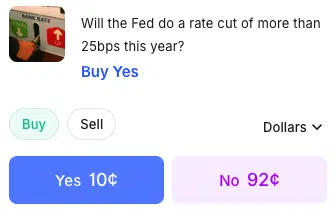
Here, we can see that:
- You can buy “yes” contracts for $0.10 each
- You can buy “no” contracts for $0.92 each
Imagine you buy 100 “yes” contracts for $0.10 each (spending a total of $10) and hold them until expiry. One of two outcomes will happen:
- The Federal Reserve cuts rates by more than 25bps: Your 100 “yes” contracts expire at $1 each for a total payout of $100. You net a $90 profit.
- The Federal Reserve does not cut interest rates: Your 100 “yes” contracts expire worthless. You lose the $10 you initially spent on those contracts.
Common Prediction Market Formats
Every individual “share” is a binary yes/no contract, but prediction market questions can take one of three formats:
- Yes or No: The standard format used for events with two mutually exclusive outcomes. Example: “Will X happen by Y date?”
- Range: Based on where a number lands in a range, with individual yes/no contracts for each range. Example: “Will the high temperature in NYC reach 82-83°, 84-85°, or 86°+ today?”
- Multiple Choice: Events with multiple potential outcomes, like elections with multiple candidates. Structured like range markets: yes/no contracts for each option.
How Prediction Markets Work
Prediction markets operate on many of the same principles as established financial markets, such as the New York Stock Exchange, to facilitate fair, efficient, and orderly trading.
Unlike an online sportsbook, where you’re betting against the house, in a prediction market, you’re trading with other users in an open order book system.
The platform itself just matches buyers and sellers and enforces the rules; it doesn’t take sides on the bet.
Trade Execution
When you decide to “bet” on an outcome, you can buy “Yes” contracts if you think it will happen or “No” contracts if you think it won’t.
There are two primary types of orders you can place:
- Market Order: An order to buy or sell immediately at the best available price.
- Limit Order: An order to buy or sell only at a specific price or better.
Market orders offer the advantages of quick execution. If you need to move into or out of a position quickly, market orders are the way to go. However, you have less control over price, and limited liquidity at the current price can result in your order being partially filled at worse prices.
Limit orders allow you to name your price, but there is no guarantee that the order will be filled if the market never moves to that price.
The Order Book
Exchanges match buy and sell orders using a central order book. The order book primarily works in the background, automatically matching buy and sell orders and displaying the current price at which you can buy or sell contracts.
The order book lists all:
- Outstanding bid orders (ranked by the price buyers are willing to pay)
- Outstanding ask orders (ranked by the price sellers are asking)
The highest bid and lowest ask define the current market price for “Yes” or “No” shares.
Whenever you place a market order, you’ll be matched with the best available counter-order in the book. For example, if someone is offering to sell “Yes” at $0.40 and you place a buy order, you’ll receive that $0.40 price.
If you place a limit order (for example, bidding thirty cents for “Yes”), your order will sit in the order book until the market moves or a seller agrees to your price.
Prediction markets handle order matching automatically, so casual users simply see the current price and trade with a click.
However, you can view the full order book to see the depth of bids and asks at various prices (this can give a sense of liquidity and what other traders are thinking).
Prediction Markets Liquidity
Liquidity is paramount in prediction markets.
A market with high liquidity has many buyers and sellers actively placing orders, resulting in a “deep” order book.
Liquidity is critical for several reasons:
- Tighter Spreads: High liquidity leads to more competition between buyers and sellers, which narrows the bid-ask spread. This directly reduces the transaction costs for traders.
- Faster Execution: With more orders on the book, it is more likely that a new order will find a match quickly at or near the current market price.
- Price Stability: In a liquid market, large orders are less likely to cause drastic price swings, resulting in more reliable and less volatile price discovery.
Conversely, an illiquid market is characterized by a “thin” order book with few orders and wide bid-ask spreads. Additionally, individual trades have a greater impact on current contract prices.
Attempting to trade in illiquid markets can be costly and difficult. For this reason, new traders should focus on the most popular markets, such as major elections or championship sporting events, where liquidity is typically highest.
Contract Resolution
Every market listed on an exchange has an expiration date and settlement rules. Each market’s rules outline how long trading remains open and the method used to determine the official result.
For example, a market asking whether gas prices will exceed $X this month may have rules stating that it closes at 11:59 PM ET on the 31st and specifying which source it will use to determine the official result.
After the prediction market resolves the event, it converts all contracts into $1 or $0 and automatically credits the winners’ accounts.
Prediction Market Categories
Prediction markets cover an ever-growing array of topics. If an event is in the future and its outcome is verifiable, there’s probably a market for it, or there soon will be.
Politics
Political markets are among the most popular and liquid on any platform. They allow traders to take positions on a wide range of political outcomes, from high-profile national elections to the intricacies of the legislative process.
See our political prediction markets and Presidential Election markets guides for comprehensive explainers, tips, and FAQs.
Examples:
- Who will win the next US Presidential Election?
- Will the government shut down by October 1st?
- Which party will control the Senate after the midterms?
- Will a specific Supreme Court nominee be confirmed?
Sports
Sports event contracts cover a wide range of outcomes, including long-term futures (e.g., “Who will win the Super Bowl”), single-game winners, point spreads, and even combos (the prediction market equivalent of sports betting parlays).
See our sports prediction markets guide for a detailed discussion, legal considerations, tips, and FAQs.
Examples:
- Will the Kansas City Chiefs win the Super Bowl?
- Will the Los Angeles Lakers win tonight’s game?
- Will Player X rush for over 80.5 yards?
Economics & Finance
Economic and financial markets allow traders to take positions on key indicators that drive the global economy.
Economic prediction markets are particularly useful for hedging, allowing businesses and individuals to protect themselves against adverse economic events like inflation or interest rate hikes.
Corporate markets also allow trading on specific company outcomes, such as quarterly earnings reports or product launch dates.
Examples:
- Will the monthly CPI inflation rate be above 3.5%?
- Will the Federal Reserve cut interest rates at its next meeting?
- Will Tesla’s Q3 earnings per share beat analyst expectations?
- Will the US enter a recession this year?
Pop Culture & Entertainment
These markets cater to public interest in cultural events, allowing people to trade on their knowledge of the entertainment industry. They cover major awards shows, box office performances, and other significant cultural topics.
Examples of culture prediction markets:
- Will ‘Film X’ win the Oscar for Best Picture?
- Will Taylor Swift release a new album by December 31st?
- Will the next major superhero movie gross over $100 million in its domestic opening weekend?
Science & Weather
This category includes markets on verifiable scientific achievements and specific, measurable weather events.
Weather betting prediction markets can serve as a form of parametric insurance, allowing individuals and businesses in affected areas to hedge against the financial impact of natural disasters and disease outbreaks.
Examples:
- Will a category 2+ hurricane make landfall on the Gulf Coast this year?
- Will July be the hottest month on record globally?
- Will OpenAI announce the release of its next model by the end of the year?
Business & Corporate
These markets allow traders to take positions on measurable outcomes related to individual companies. They typically focus on key performance indicators and milestones that can impact a company’s stock price or public perception.
Examples:
- Will a company’s quarterly earnings per share beat analyst expectations
- Will a specific product receive regulatory approval by a certain date?
- Will a company announce a new product launch by the end of the quarter?
Cryptocurrency Predictions
Crypto prediction markets focus on the outcomes and price movements of digital assets. They cater to traders with specific knowledge of the crypto industry and blockchain technology. Polymarket is the leader in cryptocurrency prediction markets.
Examples:
- Will the price of a specific cryptocurrency reach a certain level by a set date?
- Will a particular network development or upgrade occur on schedule?
- Which blockchain will have the highest trading volume in a given month?
Esports Markets
Esports markets allow users to trade on the outcomes of professional, competitive video gaming events. These markets function similarly to traditional sports markets, with contracts on tournament winners and individual match outcomes. Esports prediction markets are one of Kalshi’s strength areas.
Examples:
- Will a specific team win a major Esports championship?
- Which player will be named the MVP of a tournament?
- Will a team win their next scheduled match?
Mention Markets
Mentions prediction markets, sometimes listed as a subcategory under under politics or current events, focus on whether a public figure will mention a particular word, phrase, or topic during a scheduled public address. These markets allow traders to speculate on the messaging and focus of upcoming high-profile speeches, debates, or announcements.
Examples:
- Will the Federal Reserve Chair use the word “transitory” during a press conference?
- Will a specific political topic be mentioned during a presidential debate?
- Will a company’s CEO mention a new product line during an earnings call?
Technology & AI
Technology markets cover verifiable achievements and milestones in the tech sector, including advances in artificial intelligence. These contracts allow traders to take positions on specific product releases or scientific developments from major tech companies.
Examples:
- Will OpenAI announce the release of its next-generation AI model by the end of the year?
- Will a specific tech company receive a patent for a new innovation by a certain date?
Public Health
Health-related markets concentrate on verifiable public health events, such as disease outbreaks. These markets can also serve as a form of parametric insurance, allowing businesses or individuals in affected areas to hedge against the potential financial impact of a widespread health event.
Examples:
- Will a global health organization declare a specific virus a public health emergency by a certain date?
- Will the CDC report a certain number of flu cases during the peak of the season?
Prediction Market Bonuses
Prediction market bonuses incentivize new customers to sign up for accounts, deposit funds, and begin trading event contracts. They usually come in the form of sign-up credits and first trade match bonuses.
Once you claim an operator’s welcome bonus, you can capture additional value through ongoing rewards programs. Common promotions for existing customers include cashback-style volume rewards, liquidity incentives for trading in less popular markets, and modest referral bonuses for inviting friends.
Our prediction market bonuses guide walks through the main types of promotions each major operator offers and explains how to judge whether a promotion is worth your time.
Are Prediction Markets Gambling?
The answer depends on who you ask.
From a legal perspective, there is no single answer that covers every prediction market category. Prediction markets can serve as forecasting and hedging tools, particularly when trading contracts that resolve based on economic indicators, weather, commodity prices, and other subjects that directly impact business outcomes.
However, sports event contracts look a lot like conventional wagers in both function and marketing. Federal appeals courts have reached opposite conclusions, setting the stage for a likely Supreme Court showdown.
For now, whether a prediction market contract is legally treated as gambling depends on the contract category, state-level gambling laws, and which federal court rules on the “gambling vs financial product” question.
For some traders, especially those with a background in sports betting, the appeal lies in speculation. They may enjoy the challenge or rush of “betting” on future events.
For others, today’s prediction markets represent the democratization of a hedging tool once limited to institutional investors. Consider these scenarios:
- A small business owner in Florida whose revenue depends on tourism can buy “Yes” contracts on a hurricane making landfall. If the hurricane hits and their business suffers, the payout from the contracts can help offset their losses. This functions as a form of accessible, event-specific insurance.
- A homebuyer with a variable-rate mortgage is exposed to the risk of rising interest rates. They can buy “Yes” contracts on the Federal Reserve raising rates. If rates rise and their mortgage payment increases, the profit from their contracts can help mitigate the new expense.
- An investor whose portfolio is heavily weighted in tech stocks can hedge against a market downturn by buying “Yes” contracts on the US entering a recession.
Are Prediction Market Sites Legal?
Prediction markets are available in most states, but their legal standing is a subject of ongoing debate.
The legal question driving the debate is this: are prediction platforms federally regulated financial markets, or do they constitute online betting subject to state gambling laws? The answer will decide who regulates prediction market apps like Kalshi and Polymarket, but courts have not reached a consensus on the matter.
The Debate Over Federal vs. State Regulation
The primary reason prediction markets currently operate nearly nationwide is their classification under federal law:
- Federal Oversight: CFTC-registered platforms operate as Designated Contract Markets (DCMs). The CFTC treats event contracts as financial derivatives, not wagers, and claims exclusive jurisdiction over them under the Commodity Exchange Act.
- State Authority: In contrast, online sports betting is regulated at the state level by gaming commissions that adopt rules specifically for sports wagering. State gambling laws require operators to obtain licenses, pay state taxes, and promote responsible gambling.
The CFTC’s position is that federal law preempts state gambling rules when a contract is listed on a federally registered DCM.
Some state regulators disagree when it comes to event contracts based on sporting outcomes like who will tonight’s Monday Night Football game. Regulators in those states contend that sports event contracts are functionally sports wagers and fall under states’ long-recognized authority over gambling.
Where the Courts Stand
Federal district courts have reached opposite conclusions on the preemption question, and several of those cases have moved up to federal appeals courts.
The Third Circuit became the first federal appeals court to decide the question in April 2026. It affirmed an injunction blocking New Jersey from enforcing its gambling laws against Kalshi’s sports-related event contracts, holding that the contracts are swaps under the Commodity Exchange Act (CEA) and that federal law shields them from state regulation.
The Ninth Circuit reached the opposite conclusion in August 2026. It ruled that Kalshi’s sports event contracts are probably not swaps, which Nevada may enforce its sports betting laws. The decision does not automatically stop sports-related contracts in all states under Ninth Circuit jurisdiction because each state still needs its own gambling laws and enforcement action. However, the decision does remove the primary “exclusive CFTC jurisdiction” argument that platforms have been raising in courts.
Now that two federal appeals courts have reached opposite conclusions, the question is well-positioned for Supreme Court review.
State-Level Bans and Restrictions
Several states have gone further than most toward restricting sports-related event contracts while the broader legal battle plays out:
- Nevada: Nevada was the first state to enforce a working ban on sports event contracts and remains the most restrictive. The Ninth Circuit ruled in Nevada’s favor in August 2026, allowing the state to continue blocking event contracts based on sports. Whether prediction market platforms may offer election contracts in Nevada remains unresolved.
- Massachusetts: In early 2026, a Suffolk County Superior Court judge ruled that Kalshi’s sports contracts are subject to Massachusetts’ gaming laws. An appeals court stayed the decision, leaving sports markets available in Massachusetts while the case proceeds. However, oral arguments held in front of the Massachusetts Supreme Judicial Court in May 2026 indicate Kalshi has an uphill battle there.
- Michigan: Michigan regulators consider prediction markets based on sports to be a form of unregulated sports betting. In September 2026, a Michigan judge granted the state a preliminary injunction barring Kalshi from offering prediction markets based on sports to anyone located within state lines. Kalshi and all other major prediction market apps currently restrict sports event contracts in Michigan but still offer non-sports markets.
- Minnesota: In May 2026, Minnesota became the first state to fully pass legislation banning prediction market platforms. Provisions included in an omnibus public safety bill effectively ban all prediction markets, with felony-level violations for operators, advertisers, and individuals who assist the operation of prediction markets.
- Washington: A Washington court has forced Kalshi to block individuals in Washington from trading event contracts based on sports, elections and politics, entertainment and culture, tech and science, and mentions. Other categories (commodities, weather, economics, and finance) remain available in Washington State. The court order was specific to Kalshi, which leaves other prediction market apps to decide for themselves if they’re willing to offer the same types of contracts that prompted Washington’s lawsuit against Kalshi.
Additional states have pursued enforcement actions against operators without yet securing full-on bans, but ongoing court cases could change the picture quickly in any number of states.
See our state-specific guides to legal betting for more information on the status of prediction market platforms in every state.
CFTC Proposes Event Contract Rules
In June 2026, the CFTC proposed rules that would create a formal “public interest” framework for event contracts, including a definition of “gaming” that would cover sports. The proposal also outlines specific factors that regulators would consider when deciding whether contracts related to “gaming” are contrary to the public interest.
Under the proposed rules, markets tied to sporting event outcomes and player performances would be less likely to face CFTC objection. The proposal’s language indicates markets based on topics like final scores, point spreads, win-loss results, season-long metrics, and individual athletes’ full-game stat totals would likely not fall into the “contrary to the public interest” category.
In contrast, the CFTC would be likelier to find markets based on more granular in-game outcomes (e.g., the result of the next pitch or play), player injuries, and officiating decisions to be contrary to the public interest.
The proposal also indicates that the CFTC would view markets based on pure chance unfavorably. For example, it would likely reject contracts for something that looks like slots or blackjack dressed up as derivatives.
However, the CFTC leaves some room to treat poker and other skill-based competitions differently than games of pure chance. The proposal notes that games with a high degree of luck, like poker, can also depend significantly on skill when played over many rounds. That doesn’t guarantee that the CFTC will allow prediction market platforms to offer products that look and feel like online poker, but it does leave open the possibility.
Congressional Action on the Table
Legal prediction markets still face the possibility of additional regulation at the federal level. Congress has introduced numerous bills in recent months that would impose new restrictions on prediction markets.
The most significant is a bipartisan measure that would bar CFTC-registered exchanges from listing contracts resembling sports betting or casino gaming. State legislatures are also active. New York is considering legislation that would require state licenses for event contracts and place operators under state oversight.
Insider Trading Scrutiny
Federal scrutiny extends beyond the ongoing jurisdictional fight. Federal prosecutors in Manhattan have examined whether certain trades violated insider trading rules. The Senate has barred its members and staff from trading prediction market contracts, and a separate bipartisan bill would extend that prohibition to the House, the President, the Vice President, and senior executive branch officials.
A House investigation is also examining whether government employees have traded on nonpublic information. These developments are separate from the preemption dispute, but they show that federal authorities are taking a closer look at how prediction markets function in practice.
Prediction Markets FAQ

Wes Burns has more than a decade’s worth of experience as a writer, researcher and analyst in the legal gambling industry and is co-founder of BettingUSA.com. As a former professional online poker player, Wes approaches his work from the viewpoint of players.