
A straight bet is a wager on a single horse running in one race. The category covers the three most fundamental wagers in horse racing: win, place, and show). As such, straight bets are a natural starting point for beginners but remain a staple for veterans.
Straight bets in horse racing also include the across the board option, which combines a win, place, and show bet into a single ticket covering one horse.
Read on for our complete guide to horse racing straight bets.
Where To Place Straight Bets Online
 $200 Welcome BonusTwinSpires Offer Code: BET200
Void where prohibited. Terms and conditions apply. Offer for TwinSpires Racing only. See TwinSpires.com for details. Must be 18+ (21+ where applicable). For help with a gambling problem, call 1-800-GAMBLER.
$200 Welcome BonusTwinSpires Offer Code: BET200
Void where prohibited. Terms and conditions apply. Offer for TwinSpires Racing only. See TwinSpires.com for details. Must be 18+ (21+ where applicable). For help with a gambling problem, call 1-800-GAMBLER.
 100% up to $50AmWager Promo Code: BUSA
Promotional offer valid and continues until further notice. Open to new AmWager account holders who have not previously opened an AmWager account. Individuals may only have one (1) AmWager account and may only qualify for a signup promotion one (1) time. The First Deposit Match Bonus promotion applies to the first deposit made; any subsequent deposits will not apply. The amount of the first deposit will determine the amount of the bonus and bets that must be placed to earn the bonus. For example, to qualify for the maximum bonus of $50, an initial deposit of $50 is required and total bets must equal $50 or more within 30 days of signing up. Cancelled wagers and refunded wagers are not eligible and will not be counted towards the promotion. The total promotional wagering credits will be credited to the AmWager account in a single deposit within seven (7) business days of meeting the betting requirements for this promotion. Any promotional wagering credits deposited to a player’s account must be wagered and cannot be withdrawn from the account. Any winnings from those wagers are cash and can be withdrawn. Any portion of the promotional credits unused expires after 30 days. Account must remain in good standing to be eligible for all promotions. Returned deposits during the promotional period will cancel eligibility to receive promotional wagering credit. Limit one promotional offer per household.
100% up to $50AmWager Promo Code: BUSA
Promotional offer valid and continues until further notice. Open to new AmWager account holders who have not previously opened an AmWager account. Individuals may only have one (1) AmWager account and may only qualify for a signup promotion one (1) time. The First Deposit Match Bonus promotion applies to the first deposit made; any subsequent deposits will not apply. The amount of the first deposit will determine the amount of the bonus and bets that must be placed to earn the bonus. For example, to qualify for the maximum bonus of $50, an initial deposit of $50 is required and total bets must equal $50 or more within 30 days of signing up. Cancelled wagers and refunded wagers are not eligible and will not be counted towards the promotion. The total promotional wagering credits will be credited to the AmWager account in a single deposit within seven (7) business days of meeting the betting requirements for this promotion. Any promotional wagering credits deposited to a player’s account must be wagered and cannot be withdrawn from the account. Any winnings from those wagers are cash and can be withdrawn. Any portion of the promotional credits unused expires after 30 days. Account must remain in good standing to be eligible for all promotions. Returned deposits during the promotional period will cancel eligibility to receive promotional wagering credit. Limit one promotional offer per household.
 50% up to $300Iron Bets Racing Promo Code: BUSA
18/21+, T&Cs Apply. Gambling Problem? Call 1-800-GAMBLER
50% up to $300Iron Bets Racing Promo Code: BUSA
18/21+, T&Cs Apply. Gambling Problem? Call 1-800-GAMBLER
21+ to Play, T&Cs Apply. Gambling Problem? Call 1-800-GAMBLER
The three straight bets in horse racing include:
- Win Bet: Select one horse to win the race
- Place Bet: Select one horse to finish in first or second place
- Show Bet: Select one horse to finish anywhere in the top three
And here’s how they compare:
| Bet Type | Wins If Your Horse Finishes… | Payout Potential | Difficulty |
| Win | 1st | Highest | Hardest |
| Place | 1st or 2nd | Medium | Moderate |
| Show | 1st, 2nd, or 3rd | Lowest | Easiest |
Win Bets In Horse Racing
- Wins if your horse finishes in first place
- Loses if your horse finishes in any other position
- Straightforward, often pays well, more difficult to win than place or show bets
- Full guide: Win Bets in Horse Racing
The win bet is the simplest wager in all of horse racing. When placing a win bet, the bettor selects a single horse and collects a payout if the selection finishes the race in first place.
Win bets provide the highest payout potential among the straight bets in horse racing, but they are also the most difficult of the group. If the selected horse wins the race, the bettor collects. If the horse finishes in any other position, the bet loses.
Win Bet Odds
Bettors can see the latest win bet odds for every horse in an upcoming race by logging in to the horse racing betting site of their choice and selecting a race.
Typically, online racebooks display the current odds based on betting action along with a smaller notation showing each runner’s morning line odds (the price the track oddsmaker assigned to each runner based on anticipated betting interest).
Horse racing betting sites often display win bet odds as whole numbers rather than fractions. For example, the racebook may show a horse priced at 5-1 as “5” and a horse priced at 7-1 as “7.”
The exception is for short-priced favorites, which racebooks still display as 7-5 or 7/5, for example.
Read more about horse racing odds and calculating payouts here:
Place Bets
- Wins if your horse finishes in first or second place
- Loses if your horse finishes third or worse
- Simple, provides some margin for error in case your selection comes up just a little short, pays less than a win bet but more than a show bet
- Full guide: Place Bets in Horse Racing
Horse racing place bets take the win wager step one step further. Both involve selecting a single horse in a single race, but the place bet pays if the selection finishes in first or second place.
Whereas a win bet only pays if the horse finishes first, the place bet wins if the horse finishes anywhere in the top two. Place bets make no distinction between a first and second-place finish; they pay the same amount in either outcome. If the horse finishes in third place or lower, the bet loses.
Show Bets
- Wins if your horse finishes in first, second, or third place
- Loses if your horse finishes fourth or worse
- Good starting point for beginners, not a high-paying wager in most cases
- Full guide: Show Bets in Horse Racing
With the show bet, the bettor selects one horse and collects a payout if the horse finishes anywhere in the top three places. As long as the horse finishes in first, second, or third place, the bet wins.
Show bet payouts do not change based on the horse’s finishing position. They are simple yes or no propositions – show bets pay the same amount whether the selected horse finishes first, second, or third.
Show bets do not pay as well as win or place bets, but they offer even more margin for error. The show bet is usually not the best option for an odds-on runner or even semi-competitive entries because the payouts return so little in those cases.
Longshot outsiders are better candidates for show bets due to coming into the race with longer odds, resulting in better payouts if the horse performs well. And because the show bet pays for a top-three finish, the wager has a decent chance to win.
Bettors are unlikely to make a fortune with show bets, but they are a great way to get started because they are easy to understand and pay out fairly often.
Across The Board Bets
- Involves placing a win bet, a place bet, and a show bet on one horse
- Big upside if the horse wins (collect on all three bets)
- More expensive to lose
An across the board bet is a combination play that involves placing a win bet, a place bet, and a show bet on a single horse. The purpose is to maximize upside while also providing consolation payouts if the chosen runner doesn’t finish as well as the bettor had hoped.
With an across the board bet, there are four possible outcomes:
- Your horse wins: You collect on the win, place, and show bets
- Your horse finishes second: You collect on the place and show bets
- Your horse finishes third: You collect on the show bet
- Your horse finishes fourth or worse: You collect nothing
The across the board bet costs three times as much as a single straight bet because it involves placing three separate bets. For example, a $2 bet on a horse “across the board” will cost $6. Likewise, a $10 bet on a horse “across the board” will cost $30.
Across the board bets are more expensive to lose, but they offer the upside of potentially collecting on three different wagers for a large payout. Additionally, the bettor still wins something if the selected horse finishes second or third.
Mitigating Low Payouts for Show/Place Finishes
One thing to keep in mind is that it is not uncommon to lose money with an across the board bet on a horse that finishes in third and sometimes even in second place, depending on the horse’s odds.
For this reason, some bettors prefer to adjust their bet sizes to enhance the payout for second and third-place finishes . So rather than placing a simple $4 across the board bet (which would cost $12), the bettor might place a $2 win bet, a $4 place bet, and a $6 show bet to make sure a low payout for a second or thirdplace finish doesn’t result in a net loss.
Across the Board Bet Example
Imagine you bet $2 across the board on one horse. Your total cost is $6 ($2 on win, $2 on place, and $2 on show). Now, imagine the race results list these $2 payouts for your horse:
- Win: $9.00
- Place: $4.80
- Show: $3.20
Here’s how your wager would settle in each of the four potential outcomes:
| Finish | What You Collect | Total Return |
| 1st | Win + place + show | $17.00 |
| 2nd | Place + show | $8.00 |
| 3rd | Show only | $3.20 |
| 4th or worse | Nothing | $0 |
This example shows why across the board bets are not necessarily “safe” bets. They do provide more ways to win, but the place and show payouts do not always cover the full cost of the bet.
Win/Place and Win/Show Bets
Win/place and win/show bets are variants of across the board wagers, useful for partial coverage without paying for all three legs.
Win/Place Bets: A win/place wager is a win bet and a place bet on the same horse. As a result, a $2 win/place bet costs $4 and has three potential outcomes:
- Your horse finishes first: Both legs of your win/place bet pay
- Your horse finishes second: Only the place leg pays
- Your horse finishes third or worse: The full ticket loses
Win/Show Bets: A win/show bet places a win bet and a show bet on the same horse. Because it consists of two separate wagers, a $2 win/show bet costs $4 and also has three possible outcomes:
- Your horse finishes first: Both legs of your win/show bet pay
- Your horse finishes second or third: Only the show leg pays
- Your horse finishes fourth or worse: The full ticket loses
Win/place and win/show bets are relatively uncommon because they reduce the ticket cost by dropping the leg that often handles “consolation prize” duty.
How Straight Bet Payouts Work
Straight bet payouts come from pari-mutuel wagering pools. That means all money wagered on a specific outcome goes into a shared pool, which the winners will split after the race.
From start to finish, straight bet wagering pools and payouts go something like this:
- Wagering Pools Established: The money that bettors wager contributes to three separate pools, one each for win, place, and show bets.
- Track Takes Its Percentage: The track keeps a percentage of each pool (the takeout) before paying out winners. Win, place, and show takeout in the US typically runs around 15% to 18%.
- Winners Get Paid: Racebooks divide the remaining money among the winning tickets in each pool.
Win bets offer the biggest payouts of the three because the win pool is split only among those who selected the winning horse.
Place bets pay less than win bets because the place pool is split more ways (it pays anyone who selected either of the top-2 finishers. Similarly, the show pool is split three ways, so each bettor’s share is smaller.
Minimum Straight Bet Sizes
The standard minimum bet size on all straight bets is $2.00, but some tracks have lower minimums.
Because they contribute to each track’s official wagering pools, legal online racebooks set each race’s minimum straight bet amount based on the host track’s minimum.
How to Place Straight Bets Online
Straight bets are the easiest types of wagers to place at legal online racebooks. Fans can place straight bets by signing in to the horse racing betting site of their choice and selecting an upcoming race to visit that race’s program and wagering interface.
In most cases, the wagering interface offers win bets by default, but fans can easily use the bet type selector to choose other types of straight bets:
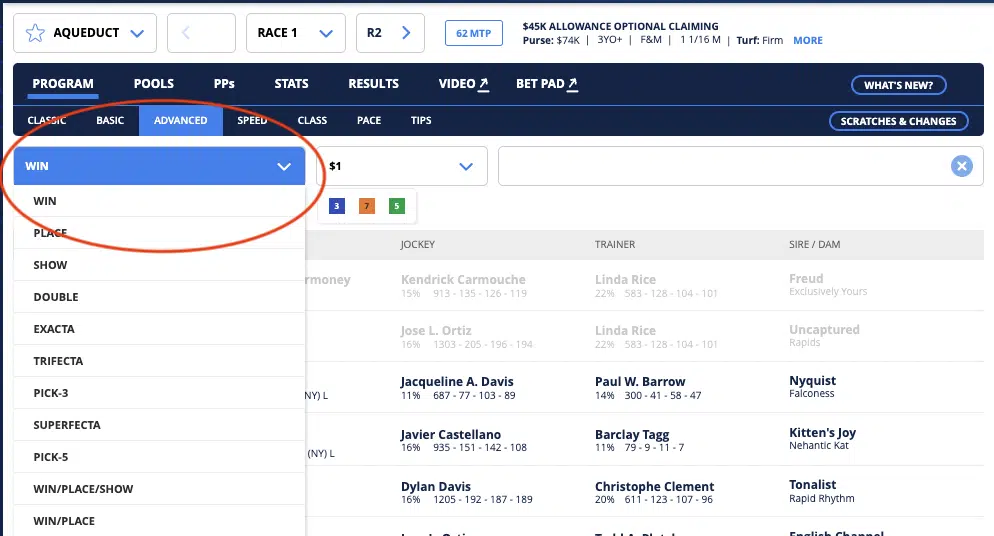
After selecting the type of straight bet they want, bettors can then select any horse, adjust the size of the wager, and submit the bet. Bettors can also place across the board bets by selecting that option from the dropdown selector. In some cases, as in the example above, the across the board bet is displayed as a “win/place/show” wager.
Straight Bet Comparison Calculator
Win / Place / Show Comparison Calculator
Compare estimated payouts across all three straight bets
| If horse finishes… | You collect | Total return | Net profit/loss |
|---|---|---|---|
| 1st | Win + Place + Show | $20.20 | +$14.20 |
| 2nd | Place + Show | $8.20 | +$2.20 |
| 3rd | Show only | $4.00 | −$2.00 |
| 4th or worse | Nothing | $0.00 | −$6.00 |
Win payout is exact (decimal odds × bet). Place and show payouts are estimates based on typical pool dynamics — actual amounts depend on the race's specific betting action.
Horse Racing Straight Bet FAQ

Wes Burns has more than a decade’s worth of experience as a writer, researcher and analyst in the legal gambling industry and is co-founder of BettingUSA.com. As a former professional online poker player, Wes approaches his work from the viewpoint of players.