
What Is Point Spread Betting, And How Do Point Spread Bets Work?
Betting on a game in which one team is clearly in a league of its own wouldn’t be the most enthralling proposition if it wasn’t for the point spread.
Otherwise known as the great neutralizer or simply the handicap, point spreads theoretically level the playing field between two teams. Point spreads can transform a rather ho-hum blowout into a nail-biting affair. If one ever hears a sports fan screaming at the screen when the score is 31-14 with 5 seconds left, it probably means they have a point spread bet on the line.
But how does point spread betting work, and how can bettors get the best bang for their buck? We explore these questions and more below.
Point Spread Betting Sites
 Play $5, Get $50 in LineupsPrizePicks Promo Code: BUSA
$50 provided as promo funds, only for use on PrizePicks. Promo funds provided under this promotion must be played within 90 days of receipt or shall become null and void at PrizePicks’ discretion. Promo ends 12/31/25. Void where prohibited. If you or someone you know has a gaming problem, get help. Crisis services and responsible gaming counseling can be accessed by calling 1-800-426-2537 or online at www.ncpgambling.org. 18+ in most eligible jurisdictions, but other age and eligibility restrictions may apply. Valid only in jurisdictions where PrizePicks operates. See prizepicks.com/terms for full PrizePicks terms of service.
Play $5, Get $50 in LineupsPrizePicks Promo Code: BUSA
$50 provided as promo funds, only for use on PrizePicks. Promo funds provided under this promotion must be played within 90 days of receipt or shall become null and void at PrizePicks’ discretion. Promo ends 12/31/25. Void where prohibited. If you or someone you know has a gaming problem, get help. Crisis services and responsible gaming counseling can be accessed by calling 1-800-426-2537 or online at www.ncpgambling.org. 18+ in most eligible jurisdictions, but other age and eligibility restrictions may apply. Valid only in jurisdictions where PrizePicks operates. See prizepicks.com/terms for full PrizePicks terms of service.
 Spend $5 Get $50 + 100% up to $100Fliff Promo Code: BUSABONUS
Void where prohibited. No purchase necessary. See terms of use for eligibility. 18+, T&Cs Apply. Gambling Problem? Call 1-800-GAMBLER.
Spend $5 Get $50 + 100% up to $100Fliff Promo Code: BUSABONUS
Void where prohibited. No purchase necessary. See terms of use for eligibility. 18+, T&Cs Apply. Gambling Problem? Call 1-800-GAMBLER.
 Play $5, Get $75Underdog Sports Promo Code: BETUSA
Must be 18+ (19+ in AL, NE; 19+ in CO for some games; 21+ in AZ, MA, and VA) and present in a state where Underdog Fantasy operates. Terms apply. Concerned with your play? Call 1-800-MY-RESET or 1-800-GAMBLER or visit www.ncpgambling.org. NY: Call the 24/7 HOPEline at 1-877-8-HOPENY or Text HOPENY (467369).
Play $5, Get $75Underdog Sports Promo Code: BETUSA
Must be 18+ (19+ in AL, NE; 19+ in CO for some games; 21+ in AZ, MA, and VA) and present in a state where Underdog Fantasy operates. Terms apply. Concerned with your play? Call 1-800-MY-RESET or 1-800-GAMBLER or visit www.ncpgambling.org. NY: Call the 24/7 HOPEline at 1-877-8-HOPENY or Text HOPENY (467369).
 Free Entry + $100 Deposit BonusParlayPlay Promo Code: BUSA
18/21+, T&Cs Apply. Welcome offer is for players who make their first successful deposit to ParlayPlay. Following the deposit, you receive promo entry(s) that matches the deposit amount up to $100. The promo entry can only be used to enter up to 4-pick More/Less contests. If you lose the promo entry, your account balance is not impacted. The deposit promo entry(s) must be used within 7 days of deposit. After 7 days the free entry will expire. If you have concerns about managing your play on ParlayPlay or anywhere else, or if you’re concerned about a family member or friend, the National Council on Problem Gambling offers support through telephone or text. They can be reached confidentially (24-hours a day) at 1-800-522-4700. Or contacted on their website at https://www.ncpgambling.org/ or through chat at ncpgambling.org/chat.
Free Entry + $100 Deposit BonusParlayPlay Promo Code: BUSA
18/21+, T&Cs Apply. Welcome offer is for players who make their first successful deposit to ParlayPlay. Following the deposit, you receive promo entry(s) that matches the deposit amount up to $100. The promo entry can only be used to enter up to 4-pick More/Less contests. If you lose the promo entry, your account balance is not impacted. The deposit promo entry(s) must be used within 7 days of deposit. After 7 days the free entry will expire. If you have concerns about managing your play on ParlayPlay or anywhere else, or if you’re concerned about a family member or friend, the National Council on Problem Gambling offers support through telephone or text. They can be reached confidentially (24-hours a day) at 1-800-522-4700. Or contacted on their website at https://www.ncpgambling.org/ or through chat at ncpgambling.org/chat.
*The options available in your state are fantasy pick’em apps and social sportsbooks, not technically sports betting.
How Point Spread Bets Work
Points spreads are typically associated with high-scoring team sports, so bettors rarely find them for sports like soccer, tennis, and MMA.
There are the major sports for which sportsbooks offer point spread betting:
- Football: NFL and NCAA
- Basketball: NBA and NCAA
- Hockey: Uses a variant of the point spread called the puck line
- Baseball: Uses a variant called the run line
- Rugby
- Lacrosse
For the sports where they’re applicable, point spread betting is typically the first featured and are often associated with other top-line straight bets like the Total (Over/Under) and the Moneyline.
Here’s a look at the main NFL odds screen at BetMGM Sportsbook as an example:

Customers who use the BetMGM web interface will notice it posts a spread for the entire game and one for the first half. The latter is a derivative and allows bettors to place spread bets on portions of games, such as the first half as exemplified above, the second half, or the third quarter in a basketball game.
Customers will sometimes find derivatives published on the front page of a sports category, but often they’ll have to click or tap on an individual game and dig a bit to find them.
How to Interpret Point Spreads
Two numbers denote point spreads. The top or left-hand side number represents how many points a team is getting or receiving, and the bottom or right-hand side number shows the odds.
So, what do they mean? Let’s address the top number first.
Imagine an NFL game where the oddsmakers price the Buffalo Bills at -3.5 vs. the Miami Dolphins at +3.5.
First, notice that the two numbers always mirror one another. That’s because point spreads are neutralizers and must cancel each other out.
The odds in this example provide several critical pieces of information to the bettor:
- The Bills are the favorite and are “giving” 3.5 points to the Dolphins. A minus sign (“-“) always denotes favorites.
- The Dolphins are the underdog (“+”) and are “getting” 3.5 points from the Bills. A positive sign (“+”) always represents underdogs.
Therefore, the Bills must win by four points or more for a point spread bet on them to cash. Likewise, the Dolphins must either win by any amount or lose by fewer than three points to cover the spread.
If the line were instead Bills -3 instead of -3.5, and the Bills win by exactly a field goal, sportsbooks would consider any point spread bets on that game a draw and refund all outstanding tickets.
How to Read Point Spread Odds
Sportsbooks typically price point spread wagers around the magical -110 number.
At -110 odds, bettors must wager $110 to win $100. Of course, bettors do not have to wager in $110 units – they can just as easily risk $55 to win $50, $220 to win $200, or even $35.58 to win $32.35.
The reason bettors don’t win even money on what’s supposed to be a 50-50 bet is that the book holds a percentage, also known as the vig. The vig on a standard -110 point spread betting is roughly 4.55%, which isn’t too high compared to other wager formats. For example, the house hold on futures bets can easily exceed 20%.
Sharp books, and there aren’t many in the US, may offer -108 or even -105 splits on point spreads. There may even be occasions when a book runs a “No Juice Spread” promo that centers the lines around +100, representing true odds.
Point spreads aren’t always perfectly balanced, but they’re usually close. Bettors may see -115/-105, -120/+100, and odd betting lines like -112/-109 from time to time. Imbalanced odds function on the same premise: if a line is -115/-105, the bettor will be risking $110 to win $100 on the first time and $105 to win $100 on the second.
Puck Lines and Run Lines
Sportsbooks tend to use variations of the point spread when pricing lower-scoring games such as hockey and baseball.
In hockey, oddsmakers set the puck line. The puck line functions the same as a point spread, except instead of attempting to level the field perfectly, the favorite almost always gives 1.5 goals (denoted as -1.5), and the underdog gets 1.5 goals (+1.5).
A 1.5 puck line may not sound like much, but it’s significant in a sport like hockey, with games often ending in scores such as 4-3, 3-2, 1-0, and so on. Even a humble 1.5-point puck line can flip the script so that moneyline favorites become puck line underdogs.
The same applies to baseball run line bets. The favored team in an MLB game gives 1.5 runs to the underdog, who can lose by a single run and still win the contest for the purposes of run line wagers. Baseball scores tend to be higher than hockey, so the impact of 1.5 runs isn’t as dramatic, but there are still a fair number of instances where moneyline favorites become underdogs under the run line.
Of course, there is no rule that says puck and run lines must always be 1.5 – it’s just the most common case. Sportsbooks occasionally issue lines such as 2.5 as well.
Run and puck lines do not perfectly balance the two teams, so the odds don’t follow the -110 rule. Instead, they’ll look more like a traditional moneyline, with a clear favorite and underdog.
How to Place Point Spread Wagers
Sportsbooks usually publish point spreads front and center on the homepage or a sport’s category page. As a result, placing a point spread bet is a simple matter, whether betting from a desktop or mobile device.
- Log in to your online sports wagering account
- Check out any featured pregame or in-play point spreads displayed on the sportsbook’s homepage or navigate to a sports category to see all available spreads for any particular league.
- Find a bet you like and click or tap it to add it to your betting slip
- The betting slip will appear on your screen and allow you to input an amount to wager
- Use the betting slip to confirm the bet, save it for later, or combine it into a parlay or other combination wager
Mobile betting apps and online sportsbooks automatically calculate the potential payouts of wagers in the slip. As such, bettors can quickly see how much they stand to win or risk on every bet before they place it.
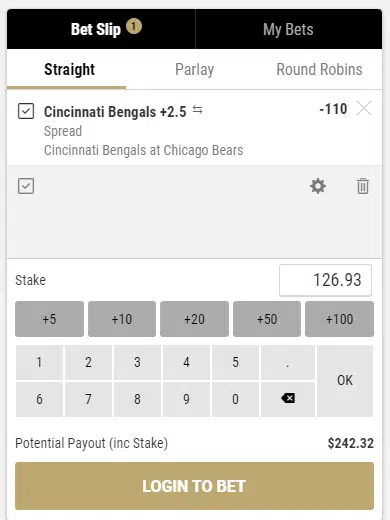
The potential payout isn’t an indication of net profits but the total return, including the initial stake. For a -110 point spread, the indicated return will be just a hair under twice the amount wagered.
Calculating the Juice on Point Spreads
For the most part, calculating the juice, or VIG, on point spreads is straightforward because the line is the same on both sides. However, this isn’t always the case, so it’s worth exploring.
We mentioned previously that the VIG on a standard -110/-110 game is 4.55%. How did we derive that figure?
First, we take the implied probability of each team winning. For negative odds the formula is:
Negative odds: (-odds)/(-odds + 100)
Which works out to (-(-110))/(-(-110) + 100) = 110/(110 + 100) = 52.38%
Since both teams have the same odds, we simply multiply 52.38% by two and get 104.76%. The 4.76% is called the overround, which creates the profit margin for the book. If sports betting had villains, the overround would be the kingpin.
To get the actual juice, the formula is: 1 – (100/104.76) * 100 = 4.55%
Not all calculations are that simple. Point spreads aren’t always even, and run/puck lines often more closely resemble moneylines. What if a run line had odds of -200/+160? How would we calculate that?
It’s the same concept, except now we also need the formula to calculate implied probability using positive odds:
Positive odds: 100/(odds + 100)
Taken together:
- Favorite: (-(-200)/(-(-200) + 100) = 66.67%
- Underdog: 100/(160 + 100) = 38.46%
Here, the probabilities add up to 105.13%, the overround is 5.13%, and the juice is 4.88%. That’s a bit high for our liking, but certainly not out of bounds.
The Against the Spread (ATS) Myth
ATS, or against the spread, is a metric of how a team performs versus the spread. Since the spread is an equalizer, if a team has an above .500 record ATS in any given situation, they’ve been defying the expectations set by the book.
That means we should always place a point spread bet when that situation occurs again, right?
Wrong. In the lead-up to a game, the media loves to spin the ATS narrative into something meaningful. Fans will often hear things like “The Mets are 11-4 ATS against the Phillies on Saturdays” or “The Falcons have a 2-5 record ATS on Monday Night Football dating back to 2017.” This sort of situational historical data is virtually meaningless.
Even recent ATS records don’t carry much weight – they’re typically just the result of normal variance. Flip a coin ten times in a row, and it might come up heads eight or more times. Likewise, an NFL team might go 8-2 ATS in their last ten games, or they might go 2-8.
Bookmaking is dynamic. In the rare instance where the bookmaker, and subsequently the sharps, are wrong about a team, they will swiftly account for any errors in their models. Any meaningful trends will be baked into the line by the time the next game rolls around, rendering the ATS metric useless.
If a fan hears an analyst spouting about why everyone should bet on a team based on this-or-that ATS statistic, it’s probably time to change the channel.
Point Spreads and In-Play Betting
If a sportsbook offers pregame point spread betting, it likely provides in-play or “live” spread bets on that same game.
Beyond the obvious, the main difference between pregame and in-play wagering is that in-play point spreads are subject to rapid movement. A single missed free throw will shift an NBA point spread slightly, while a fumble at the opposition’s 20-year line could have a tremendous effect on an NFL point spread, and so forth.
Sportsbooks tend to make greater errors when it comes to in-play wagers. The reason is that they often have days to hammer down their pregame line, but they must calculate and recalculate in-play betting odds constantly. And those calculations must happen quickly.
Due to this increased margin of error, in-play point spreads typically have a higher vig. It’s more common to see -115 or -118 than it is -110 on live spreads. Even so, there’s more value to be had betting in-play lines than betting an NFL spread 2 hours before kickoff.
Point Spread Betting Tips
- As a rule, the more popular the market, the more efficient the point spread. NFL point spreads are highly efficient and unbeatable long-term. Division II NCAA and darts – less efficient.
- Understand key numbers in football: Due to the nature of scoring, certain numbers carry much more weight in the NFL. 3,6,7,10 are all critical numbers, while 8 is basically dead. Movement around key numbers is worth more. If you find a book offering an NFL point spread betting of +3.5 vs. another offering +3, you’ll often win by .5 points (otherwise known as the hook). Bet the +3.5. It’s also worth noting that key numbers are less critical in NCAA football because there is less scoring
- In the NBA, the scores are much higher, and there’s a wider scoring distribution, so key numbers are less impactful. That said, the most common margins of victory are between 2 and 9 points, so movements within that range carry greater weight. Contrary to NCAA football, NCAA basketball scores are lower relative to their pro counterpart, meaning each half-point is worth more when point spread betting.
- Know when to line shop: The most significant line movements occur shortly after a line is posted and when injury reports and starting lineups are released. Knowing when those times are can help you pick off stale lines. Just be fast.
- Shop alternatives/derivatives: There’s more value to be found shopping alternative spreads and derivatives like the first quarter or second half than the standard pregame spread.
It’s also useful to know how to calculate the difference in value between two slightly different spreads. Is +3 -110 better than +3.5 -125? These are more advanced calculations but are certainly worth keeping in mind as you continue along your sports betting journey.
Point Spread Betting FAQ
Robert Dellafave is an expert sports bettor, professional gambler, and advocate for the fair treatment of sports bettors.