
If you live in a state that lacks legal online casinos, there are alternatives that resemble online gambling without breaking the law: online sweepstakes casinos.
Sweepstakes casinos are “no purchase necessary” websites or apps where you can play casino-style games like slots, blackjack, roulette, and sometimes even live dealer games for cash prizes. Most importantly, sweepstakes casinos are available in more than 40 states.
Legal Online Sweepstakes Casinos
 200K GC + 20 SC + 10 Free SpinsCasino.Click Promo Code: None Needed
Gameplay can be harmful if not kept in control, please play responsibly. See https://casino.click/responsible-gaming. NO PURCHASE NECESSARY to enter Sweepstakes. SWEEPSTAKES ARE VOID WHERE PROHIBITED BY LAW. See T&Cs. Casino Click Social Gaming Platform is only open to Eligible Participants, who are at least eighteen (18) years old or the age of majority in their jurisdiction (whichever occurs later) at the time of entry. For detailed rules, see https://casino.click/sweeps-rules.
200K GC + 20 SC + 10 Free SpinsCasino.Click Promo Code: None Needed
Gameplay can be harmful if not kept in control, please play responsibly. See https://casino.click/responsible-gaming. NO PURCHASE NECESSARY to enter Sweepstakes. SWEEPSTAKES ARE VOID WHERE PROHIBITED BY LAW. See T&Cs. Casino Click Social Gaming Platform is only open to Eligible Participants, who are at least eighteen (18) years old or the age of majority in their jurisdiction (whichever occurs later) at the time of entry. For detailed rules, see https://casino.click/sweeps-rules.
 35 Free Sweepstakes CoinsWOW Vegas Promo Code: None Needed
No purchase necessary. Void where prohibited by law. 18+, T&Cs Apply. Gambling Problem? Call 1-800-GAMBLER
35 Free Sweepstakes CoinsWOW Vegas Promo Code: None Needed
No purchase necessary. Void where prohibited by law. 18+, T&Cs Apply. Gambling Problem? Call 1-800-GAMBLER
 25 Stake Cash + 250K Gold CoinsStake.us Promo Code: Not Needed
No purchase necessary. Void where prohibited by law. 21+, T&Cs apply. Gambling problem? Call 1-800-GAMBLER
25 Stake Cash + 250K Gold CoinsStake.us Promo Code: Not Needed
No purchase necessary. Void where prohibited by law. 21+, T&Cs apply. Gambling problem? Call 1-800-GAMBLER
 5 Sweeps CoinsHigh 5 Casino Promo Code: Not Needed
SWEEP PLAY IS VOID WHERE PROHIBITED BY LAW. Must be at least 21 years or older to participate. For further details, see Official Sweepstakes Rules. Gameplay may be harmful. Please play responsibly
5 Sweeps CoinsHigh 5 Casino Promo Code: Not Needed
SWEEP PLAY IS VOID WHERE PROHIBITED BY LAW. Must be at least 21 years or older to participate. For further details, see Official Sweepstakes Rules. Gameplay may be harmful. Please play responsibly
How Online Sweepstakes Casinos Work
Sweepstakes casinos look and feel a lot like regular online casinos. You still sign up for an account, pick from a lobby of slots and table games, spin reels, and hope to see your balance go up instead of down.
The big difference is what happens behind the scenes: instead of staking cash directly on each spin, you’re playing with virtual currencies that function as entries into a promotional sweepstakes. It adds an extra step to the experience, but it’s the key to their legality.
At standard US online casinos, the relationship is straightforward: you deposit dollars, you wager dollars, and you withdraw dollars.
At sweepstakes casinos, you move between at least two types of currencies (usually called “Gold Coins” and “Sweeps Coins”), each with its own rules, but only one is redeemable for cash or prizes.
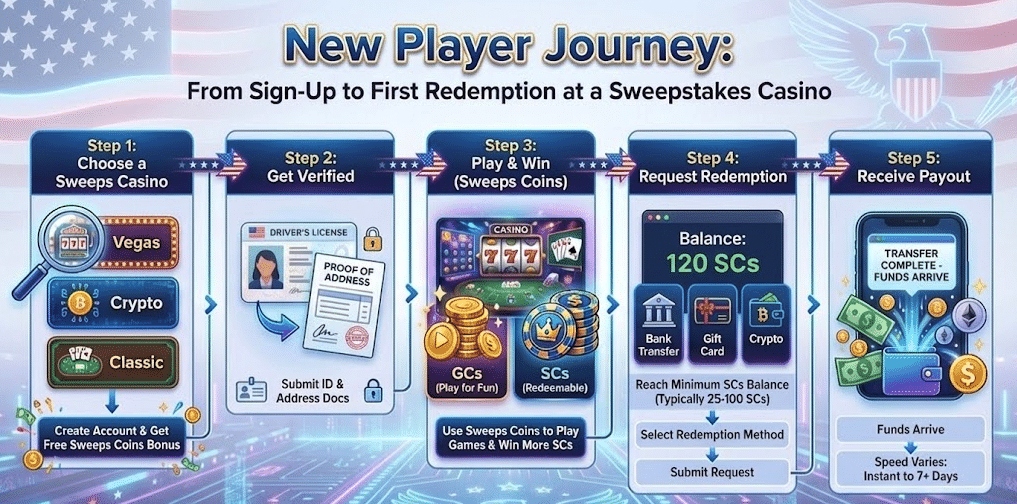
Here’s how the typical player’s customer journey looks when using a sweepstakes casino:
The Dual Currency System Explained
When you log into a sweepstakes casino, you’ll see two different balances (or a toggle to switch between the two) at the top of your screen.
One balance is for Gold Coins, and one is for Sweeps Coins. Most casinos use that exact nomenclature, but some use different names. Whatever they’re called, this is the basic idea:
Gold Coins (GCs)
Gold Coins are the “for fun” currency. You receive GCs for free when you sign up and through daily login bonuses. You can also buy Gold Coin packages for entertainment play. Most importantly, you cannot redeem GCs for cash or prizes.
- Purpose: Strictly for entertainment and fun.
- Value: No monetary value. Cannot be redeemed.
- How to get them: Can be purchased in packages.
- Availability: Given freely and sold in bulk.
Sweeps Coins (SCs)
Sweeps Coins are the sweepstakes currency. You cannot buy SCs directly. You can only receive them via bonuses, free promotions, and the “alternative method of entry “ (AMOE), typically a handwritten request sent by mail.
- Purpose: Used for promotional play and prizes.
- Value: Redeemable for cash or gift cards (usually 1 SC = $1).
- How to get them: CANNOT be purchased directly.
- Availability: Earned as a bonus when buying GCs or via free promos.
In short, Gold Coins are for “entertainment only” play, while Sweeps Coins are your entries into a promotional sweepstakes that happens to look very much like an online casino.

The “No Purchase Necessary” Rule
The entire sweepstakes model rests on a simple legal principle: you must be able to participate without having to pay.
In a typical gambling law analysis, three elements classify an activity as “gambling”:
- Chance: The result is random or partly random
- Consideration: You pay something of value to participate
- Prize: You can win something of value.
Sweepstakes casinos lean on the argument that they remove the “consideration” element by offering at least one genuinely free way to obtain Sweeps Coins, most often a mail-in request.
Legislatures and attorneys general in several states have begun questioning that argument, especially where the experience looks and feels indistinguishable from that of a real-money casino. Nonetheless, the alternative method of entry (AMOE) route remains the legal foundation of the business model.
For players, the key takeaway is simple: even if you never buy Gold Coins, you must have some realistic way to get Sweeps Coins for free.
How to Get Free Sweeps Coins
Legitimate sweepstakes casinos provide a few ways to get free SCs. The most common mechanisms include daily login bonuses, social media promos, mail-in requests, and as bonuses when purchasing Gold Coins.
Daily Login Sweeps Bonuses
Most sweepstakes casinos give you a small bundle of Gold Coins, and sometimes a fraction of a Sweeps Coin, just for logging in. Over time, daily login bonuses add up:
Monthly Daily Login Bonus Calculator
Select which sweeps casinos you’ll use to see the total value of daily login bonuses you can earn every month.
Register and Start Claiming Your Bonuses:
Social Media and Email Promotions
Sweepstakes casinos regularly run giveaways on social platforms or via email (e.g., “comment to win,” “retweet for a chance at X Sweeps Coins”). These are usually pure sweepstakes promotions with no purchase required and can be a meaningful source of playable coins if you stay engaged.
Gold Coin Purchase Bonuses
In practice, most players acquire Sweeps Coins as “bonus entries” attached to Gold Coin purchases. From the operator’s perspective, you’re paying for Gold Coins, and they’re giving you free entries into a sweepstakes as a promotional perk. From a player’s perspective, that distinction can feel academic, which is one reason regulators have started to take a closer look at online sweepstakes casinos.
Alternative Method of Entry (AMOE)
The mail-in route is the mandatory legal safety valve. Typically, you mail a handwritten or printed request with your name, address, and account details to a specified PO box. In return, the operator credits your account with a set number of Sweeps Coins. Most players never bother with this, but it matters for the legal structure.
Sweepstakes Casinos Compared
| Casino – SCs Bonus | Game Types | Minimum Redemption (SCs) | Typical Payout Time |
| WOW Vegas – 35 SCs | ~2,000 games; slots, scratch cards, shooting/arcade, live dealer | 20 SCs for gift cards; 50 SCs for cash prizes | 3-5 business days |
| Stake.us – 25 SCs | Extensive library of slots, table games, and live dealer games; Stake Originals like crash and plinko | ~50 SCs, depending on chosen cryptocurrency and price | Typically a few hours to two business days |
| Casino.click – 20 SCs + 10 Free Spins | Slots, casual games (mines, plinko, etc.), live dealer games | 100 SCs | 24 hours via crypto; 2-10 business days via bank transfer |
| Ace.com Casino – 25 SCs | Slots only; high-profile providers but no table games or live dealer | 10 SCs for gift cards; 75 SCs for cash prizes | Gift cards nearly instant; 3-5 business days for other methods |
| High 5 Casino – 5 SCs | Massive library; slots, table games, and live dealer; slingo and crash-style games | 50 SCs for gift cards; 100 SCs for cash prizes | Gift cards nearly instant; 3-5 business days for other methods |
Welcome bonuses, game libraries, and redemption rules are useful metrics for ranking the best sweepstakes casinos, but it’s also worth considering which type of brand best suits your playing style.
Broadly speaking, we can place most sweepstakes casinos into three major categories: Vegas, Crypto-Native, and Classic.
The “Vegas Experience”
- Top Picks: WOW Vegas, McLuck, Pulsz
- Best For: Players who want the exact same games found in Las Vegas or Atlantic City.
These are the operators that try hardest to look and feel like modern, regulated online casinos. They license real casino games from top-tier developers like Pragmatic Play, NetEnt, and 3 Oaks Gaming.
“Vegas Experience” sweepstakes casinos don’t offer generic slots or knock-off versions of popular games. They offer real, well-known slots like Sugar Rush 1000 or Buffalo Megaways that players would find in Las Vegas or at one of New Jersey’s licensed online casinos.
The upside is familiarity and a sense of professionalism. The trade-off is that these brands may be more visible to regulators precisely because they look like “real casinos,” which can lead to sudden state-by-state withdrawals (or software providers pulling their games) when laws change or enforcement ramps up.
Crypto-Native, Fast-Banking Operators
- Top Picks: Stake.us, LuckyBird.io
- Best For: Tech-savvy players who demand instant payouts.
This group leverages cryptocurrency for speed and flexibility.
The biggest complaint regarding sweepstakes casinos is slow redemption times. Crypto-native sites solve the slow cashouts problem.
By using cryptocurrency (Bitcoin, Litecoin, Ethereum, etc.) for banking, sites like Stake.us can process redemptions in minutes rather than days.
Additionally, crypto casinos typically support lower minimum redemption amounts and more frequent promotions.
The trade-off is that there is a higher barrier to entry. You need to know how to use a crypto wallet, and crypto sweepstakes casinos often have stricter state restrictions. If you value fast payouts and don’t mind the crypto learning curve, these sweepstakes sites can be attractive. If you’re crypto-averse, they may feel unnecessarily complex.
Proprietary “Classic” Social Casinos
- Top Picks: Chumba Casino, LuckyLand Slots
- Best For: Players who want well-known operators with proven longevity and exclusive games.
Finally, there are the incumbent sweeps casinos built on proprietary software. Think of long-running brands with their own in-house slot catalogs and distinctive art styles.
These sweepstakes gambling sites don’t rely on third-party studios. Instead, everything is built and controlled internally.
Sweepstakes casinos often have large customer bases and long track records of processing redemptions via traditional gambling banking methods.
“Classic” sweepstakes casinos have two main downsides.
First, they rarely publish return-to-player (RTP) information because the games are in-house. That makes it harder to compare your odds with other online sweepstakes casinos.
Second, payouts can be slower and more “old school” (bank transfers, paper checks by mail, and longer processing times).
For risk-averse players, longevity and familiarity can be comforting. For more analytical players, the lack of transparency around RTP and game math is a downside.
Best Sweepstakes Casino Games
New sweepstakes players frequently ask whether the slots are rigged or have lower payout percentages than regulated online casinos.
That’s a fair question, especially since players often accuse sweepstakes casinos and regulated operators alike of hosting rigged games. Many of those complaints are from players who are frustrated after experiencing the wrong side of typical variance, but some undoubtedly have merit.
The answer is that it depends on where you play. You can significantly reduce the odds of experiencing rigged games and poor RTPs by using sweepstakes casinos that:
- Are established, well-known, and reputable
- Offer online slots from recognized studios like NetEnt, Big Time Gaming, etc.
When an operator licenses games from established providers, those games typically advertise an RTP range similar to the real-money versions found at land-based casinos and licensed gambling sites (often somewhere in the mid-90s to high-90s).
Sweeps Casinos with High RTP Slots
Return to player (RTP) is the percentage of wagered money a slot machine pays back to players over time.
A higher RTP is better, but it’s worth emphasizing that RTP is only a long-term average, not a guarantee – especially over a single session.
- High RTP Sweepstakes Slots: Brands that license games from major studios are bound by the developer’s certified RTP (to an extent), typically ranging from 94% to 96.5%.
- Specific Examples: Look for games like White Rabbit by Big Time Gaming (97.24% RTP) or Mega Joker by NetEnt (99% RTP). These statistics are hard-coded by the developer, not the casino.
A few key points:
First, know that RTP is theoretical and long-term. Even if a game has a 96% RTP figure, your personal results over a small sample can be dramatically better or worse.
Second, the RTP for some games at a sweepstakes casino may differ from the configuration used in regulated markets, even if the games look identical. Operators can often choose from several “math models” offered by the supplier.
Still, it’s better to take a combination approach where you (a) stick to popular slots from well-known developers and (b) use established sweepstakes casinos only.
When in doubt, look for:
- Games from recognizable studios
- Published RTP information in the game’s info menu
- Independent testing certificates where available
Proprietary games built entirely in-house by obscure sites, with no published RTP and minimal transparency, deserve extra caution.
Neither category is “automatically safe” or “automatically bad.” All else being equal, brand-name providers with at least some transparency is a healthier sign than a wall of in-house games with no details about how they work.
Sweepstakes Casinos with Live Dealer Games
Live dealer table games are still relatively rare in the sweeps world, but they are starting to appear on a handful of operators. Sweeps casinos like Stake.us and WOW Vegas offer live dealer blackjack, roulette, and baccarat streamed from professional studios with human dealers
Where they do exist, games like live dealer blackjack and roulette can be a significant differentiator because:
- The rules are often closer to what you’d see in a land-based or regulated online casino (clear house edge, visible dealing, standard rules).
- The experience feels less like a video game and more like a conventional casino session.
If live dealer play is important to you, check each operator’s lobby (or see our recommendations above) before you invest time grinding daily bonuses. Most sweeps sites still offer only RNG-based tables and slots.
Are Sweepstakes Casinos Safe?
When discussing online sweepstakes casinos, safety is relative.
Sweeps casinos comply with all applicable laws, but they’re unregulated in the traditional sense (unlike state-licensed online casinos in New Jersey). As a result, you need to be vigilant.
That doesn’t mean all sweepstakes casinos are scams. Many pay out as promised and have operated for years. But it does mean:
- You don’t have access to formal, legally mandated complaint mechanisms like you would with licensed online casinos.
- If something goes wrong, you have little recourse. Instead, you’ll be dealing with private dispute resolution, arbitration, or class actions rather than a state gambling board with enforcement power.
Practical Risks: What Can Actually Go Wrong?
The most common pain points we see in player complaints posted online and legal filings are related to redemptions and identity verification procedures.
A good example is a complaint we’ve seen for years: new players can buy Gold Coins instantly with no verification, but the same site will insist on a full ID check as soon as you attempt to redeem real cash.
Assuming you avoid completely unknown, fly-by-night operators, these are the most realistic risks you face with online sweepstakes casinos:
- Withdrawal delays: Especially for first-time redemptions or larger cashouts. KYC queues and manual reviews can stretch into weeks at weaker operators.
- Ambiguous promotional terms: Confusion over wagering requirements, expiry dates, or what counts as “abuse” of free-coin offers.
- Identity verification delays: Requests for extra documents, slow responses, or account locks if information doesn’t match exactly.
- Sudden jurisdiction changes: Operators abruptly cutting off specific states due to new laws or regulatory pressure, sometimes freezing accounts during the transition.
None of these risks are unique to sweepstakes casinos, but they are more likely in an environment where the rules are evolving and oversight varies state by state.
The Reality of Redemptions and KYC
If you browse sweepstakes discussions on public forums or social media, you will often see complaints about “verification loops.” Here is the reality: legitimate sweepstakes casinos must verify who you are.
Unlike illegal offshore casinos, which might skip ID checks to fly under the radar, legitimate sweeps casinos adhere to strict Know Your Customer (KYC) protocols.
Here’s what to expect when redeeming Sweeps Coins for prizes:
- Before your first redemption: You will be asked to upload a photo of your Driver’s License and a Proof of Address (utility bill or bank statement).
- Completing your first redemption: Your first redemption will almost always be slow (3–7 days) as they verify your documents.
- Subsequent redemptions: Once you’re verified, subsequent redemptions are much faster, often 1-3 days for bank transfers or instant for crypto.
Sweepstakes Redemption Speeds and Withdrawal Methods
How long it takes to withdraw and which methods are available vary by operator. High-quality operators process redemptions within a day or two, but even the best sweepstakes casinos must complete identity verification before issuing your first payout.
There’s a lot of variance in payout methods, speeds, and limitations based on the operator, your account status, and even the current price of Bitcoin. That said, here’s a rough overview of what you can reasonably expect for the most common redemption methods:
| Redemption Method | Typical Withdrawal Time for Verified Players | Notes |
| Bank Transfer (ACH/eCheck) | 3-5 business days | Simple, convenient, and an option for most players (all you need is a bank account); slower than gift card and crypto transfers |
| Prizeout (digital gift card) | Up to 24 hours; often instant | Redeem your coins for a digital gift card for the retailer of your choice; the fastest non-crypto method, but you lose the flexibility of cash |
| Skrill | Up to 48 hours; often within 24 hours | Skrill is an e-wallet like PayPal; faster than bank transfers but not as widely supported |
| Cryptocurrency | Instant to 24 hours | The fastest withdrawal method for sweepstakes casinos; inconvenient if you don’t already use crypto |
Are Sweepstakes Casinos Legal?
Yes, at least in most states.
More precisely, sweepstakes casinos operate in a legal gray area in most states, neither explicitly authorized nor prohibited.
In some states, the law clearly prohibits online sweepstakes casinos. In yet others, gambling regulators contend that sweepstakes casinos constitute illegal gambling and have issued cease-and-desist orders. Such orders have yielded mixed results.
To further complicate matters, different sweepstakes casinos don’t always have the same accepted/restricted states. One sweepstakes casino may block residents of your state, while another may accept players in your state.
See our individual sweepstakes casino reviews (near the top of this page) for current lists of accepted and restricted states by operator.
Continue below for a high-level overview of the state-by-state legal landscape for sweepstakes casinos in the USA.
States That Explicitly Prohibit Sweepstakes Casinos
Lawmakers and regulators in the following states have enacted legislation banning sweepstakes casinos:
- California: AB-831 (Oct 2025) banned the operation of any “online sweepstakes game.”
- Connecticut: SB 1235 (June 2025) prohibited sweepstakes promotions that simulate or offer participation in online casino gambling or sports wagering.
- Louisiana: Attorney General’s opinion (July 2025) concluded that “online sweepstakes casino businesses” constitute illegal gambling. Most operators have exited Louisiana.
- Montana: SB 555 (May 2025) banned “online casinos, by whatever name known,” that transmit or receive gambling information and pay out in any currency.
- Nevada: SB 256 (June 2025) effectively banned sweepstakes casinos by strengthening the penalties for unlicensed online gambling and prompting operators to cease serving residents.
- New Jersey: A 5447 (August 2025) effectively banned real-money sweepstakes casinos by implementing more stringent requirements on sweepstakes-style promotions.
- New York: S5935A (December 2025) banned operating, conducting, and promoting “online sweepstakes games.”
- Washington: Existing law prohibits sweepstakes casinos, and courts have upheld that interpretation; reputable sweepstakes casinos have long blocked customers from Washington.
States Applying Heavy Pressure Without Formal Bans
Some states have effectively banned sweepstakes casinos through legal threats alone, while others have struggled to convince operators to cease serving residents. Additional states are likely to follow suit.
Every sweepstakes casino restricts customers from certain states based on its own risk assessment and interpretation of state law.
- Arizona: Cease-and-desist orders forced some sweepstakes casinos to exit the market, but several major operators remain active.
- Delaware: Aggressive regulatory posture and cease-and-desist orders in 2025 prompted some sweepstakes casinos to cease serving residents. Some prominent sweepstakes casinos remain active in Delaware.
- Maryland: Cease and desist orders pushed multiple operators out, and a 2025 bill to ban sweepstakes casinos in Maryland fell short of passage.
- Michigan: Multiple cease-and-desist orders and active enforcement efforts have prompted most mainstream sweepstakes casinos to exit the Michigan market.
- Mississippi: The Mississippi Gaming Commission sent numerous cease-and-desist letters in 2025 but has yet to dislodge all active operators.
- Pennsylvania: The Gaming Control Board issued numerous cease-and-desist orders in 2025 but noted limited statutory authority; it has urged lawmakers to adopt a formal ban. Some operators have exited Pennsylvania, but others remain active.
The bottom line: anti-sweepstakes sentiment is growing, and the legal landscape is changing faster than it did in the early years of social casinos. If you play at sweeps casinos, you should expect more state-by-state changes ahead.
Class Action Lawsuits Also Threaten Sweepstakes Casinos
Sweepstakes casinos face mounting civil exposure from class action lawsuits. What began as a handful of filings in 2024 has become a flood that threatens the model’s long-term viability.
In 2025 alone, former players (many represented by consumer protection law firms) filed dozens of class actions accusing operators of running criminal gambling enterprises, engaging in deceptive advertising, and violating consumer protection laws. Plaintiffs typically seek refunds of losses, injunctions halting operations, and, in some cases, multiplied or punitive damages.
In late October 2025, gaming attorney Daniel Wallach estimated that more than 80 active lawsuits were pending nationwide, including nine new class actions filed in a single 48-hour period. The volume and scope of these cases pose significant financial and reputational risk. Each new filing raises the chance of unfavorable precedent or costly settlements, further compounding the state-level regulatory pressure noted above.
Operators continue to defend these suits by asserting compliance with sweepstakes law, emphasizing free-play options, and denying that payments are required to participate. Many have blocked customers from higher-risk states, rewritten their terms of service, or settled selected cases to limit exposure.
A Gaming Attorney’s Take on Sweepstakes Casinos
Because sweepstakes sites resemble online casinos, many players question their legality. So how can popular sweepstakes sites continue operating even as regulatory pressure ramps up in numerous states?
To fully understand the legality of sweepstakes and contests, one must understand how they differ and what constitutes gambling.
Tamara Malvin, Partner at Akerman LLP, a firm that specializes in gaming, hospitality, sports, and entertainment, explained it this way in an interview with BettingUSA’s Steve Ruddock:
“Gambling is comprised of three elements: chance, consideration, and prize. Game promotions stay outside the realm of Gambling because they are missing one of these three essential elements.
“A contest includes consideration and prize, but participation involves skill rather than chance. That is why fantasy sports and daily fantasy sports proponents have argued tirelessly that fantasy is a contest, involving skill, and therefore not a gambling enterprise.
“A sweepstakes is another type of promotion, comprised of only chance and prize. To ensure that a sweepstakes offering does not become an unlawful gambling operation, it is essential that there be no required payment or non-monetary contribution in order to participate.”
That said, like gambling laws, sweepstakes legality is quite nuanced and varies by jurisdiction.
As Malvin explains:
“As with gambling laws and rules, the individual states dictate by statute their stances and regulations pertaining to game promotions. Florida and New York, for example, each require prior submission and effective approval for sweepstakes with prizes valuing over $5,000. Rhode Island is also known for its strict promotions regulation.
“The online offering of a sweepstakes is not only regulated by the state in which the offering company hubs its website or is headquartered, but is regulated by any state in which the company allows people to participate.
Because staying on top of fifty different jurisdictions can be difficult, operators often include the phrase “Void Where Prohibited” in their terms and conditions of sweepstakes participation. That certainly does not fully insulate them, but it is a phrase widely known to consumers as making clear that participation (and therefore prize-winning) requires lawful entry in the first place.”
The million-dollar question is whether or not these platforms fall under sweepstakes laws.
“We continue to see ingenuity in the sweepstakes realm because it is difficult to break into the highly regulated gaming market,” Malvin said. “It is easier and quicker to profit from the production and rollout of a product that feels like gaming but remains technically just outside.”
But as Malvin suggests, are they genuinely remaining outside the real-money gambling box?
“If chance and prize are involved, then there cannot be any form of consideration from the player. That means the player should not be purchasing anything in order to play (another well-known phrase “No Purchase Necessary” governs all sweepstakes). It also goes beyond purchasing. A player should not be forced to provide anything of value that can be viewed as consideration—such thing of value is fairly amorphous; it can even be in the form of “likes” on a social media page, for example.”
Sweepstakes Trade Association: The SPGA
In 2024, ten sweepstakes operators formed the Social and Promotional Gaming Association (SPGA), likely in response to increased scrutiny from regulators and the public at large.
In a statement, the SPGA explained that its mission is to “highlight the well-established legality and legitimacy of social sweepstakes games, providing regulators, policymakers, and consumers with a comprehensive understanding of these offerings.”
Additional details on the SPGA website outline how the organization approaches its four overarching objectives:
- Player Protection: Encourage responsible gambling, establish uniform customer age verification processes, and use current technology to accurately geolocate all players
- Industry Advocacy: SPGA members must establish the legality of their platforms, distinguish their offerings from gambling, and ensure compliance with all applicable laws (state and federal)
- Consumer Education: Advertise responsibly, adhere to best practices in all disclosures, clearly communicate information about the odds of winning, how sweepstakes games work, and ways to participate for free
- Support Industry Growth: Develop rules and regulations for SPGA members that foster innovation while maintaining consumer protection standards
In light of the regulatory risks sweepstakes sites face today, industry advocacy is the SPGA’s most critical mission in the short term.
As Seth Schorr of FSG Digital Inc explained in a statement, the SPGA is “committed to helping regulators and policymakers understand how our industry’s products work and how they comply with the appropriate state and federal laws.”
Sweepstakes Casinos FAQ

Wes Burns has more than a decade’s worth of experience as a writer, researcher and analyst in the legal gambling industry and is co-founder of BettingUSA.com. As a former professional online poker player, Wes approaches his work from the viewpoint of players.

Steve Ruddock is the content director for BettingUSA and the Editor-in-Chief of Gaming Law Review.
Steve has covered the legal and legislative developments in the US gambling sector for more than a decade for online and print publications.