
Credit cards are no longer the nearly universal deposit method they once were for online sports betting and gambling.
Most major online betting brands no longer accept credit deposits, and a growing number of states have enacted laws prohibiting operators from accepting credit card payments. Between operators voluntarily refusing credit card deposits and state-level bans, the list of places where bettors can fund their online gambling accounts with credit cards keep shrinking.
Read on for the latest on which online sportsbooks and casinos accept credit cards today, which states ban them outright, what to do when deposits get declined, and the next-best alternative payment methods.
Best Credit Card Betting Sites
 Second Chance Bet Up To $500BetRivers Bonus Code: BUSA
Gambling problem? Call or TEXT 1-800-GAMBLER. 21+ and present in AZ, CO, DE, IL, IN, IA, LA, MD, MI, NJ, NY, OH, PA, VA, or WV. Welcome bonus for new customers only. Bonus issued as non-withdrawable bonus bets. Min. odds and other restrictions apply. Visit BetRivers for full T&Cs.
Second Chance Bet Up To $500BetRivers Bonus Code: BUSA
Gambling problem? Call or TEXT 1-800-GAMBLER. 21+ and present in AZ, CO, DE, IL, IN, IA, LA, MD, MI, NJ, NY, OH, PA, VA, or WV. Welcome bonus for new customers only. Bonus issued as non-withdrawable bonus bets. Min. odds and other restrictions apply. Visit BetRivers for full T&Cs.
 Bet $5, Get $150Hard Rock Bet Promo Code: Not Needed
Offered by Seminole Hard Rock Digital, LLC. Must be 21+ and physically present in AZ, FL, IN, MI, NJ, OH, TN or VA to play. Terms and conditions apply. In IN, if you or someone you know has a gambling problem and wants help, call 1-800-9-WITH-IT. In AZ call 1-800-NEXT-STEP or text NEXTSTEP to 53342. In FL, call 1-888-ADMIT-IT. GAMBLING PROBLEM? CALL 1-800-GAMBLER (NJ, OH, TN, VA)
Bet $5, Get $150Hard Rock Bet Promo Code: Not Needed
Offered by Seminole Hard Rock Digital, LLC. Must be 21+ and physically present in AZ, FL, IN, MI, NJ, OH, TN or VA to play. Terms and conditions apply. In IN, if you or someone you know has a gambling problem and wants help, call 1-800-9-WITH-IT. In AZ call 1-800-NEXT-STEP or text NEXTSTEP to 53342. In FL, call 1-888-ADMIT-IT. GAMBLING PROBLEM? CALL 1-800-GAMBLER (NJ, OH, TN, VA)
Online Sportsbooks That Accept Credit Cards
Three major sportsbook brands still allow customers to fund their accounts with credit cards in states that haven’t banned credit cards for online gambling:
| Sportsbook | Accepted Brands | Minimum Credit Card Deposit |
| BetRivers Sportsbook | Visa, Mastercard, Discover, and American Express | $10.00 |
| Hard Rock Bet | Visa, Mastercard, Discover, and American Express | $10.00 |
Note: It looks increasingly likely that even these online sportsbooks will eventually stop accepting credit deposits for reasons we’ll explain below.
Online sportsbooks that no longer accept credit cards (or never did):
- Caesars Sportsbook: Stopped accepting credit cards in April 2026
- Bet365 Sportsbook: Stopped accepting credit cards in April 2026
- FanDuel Sportsbook: Banned credit cards in March 2026
- BetMGM Sportsbook: Banned credit cards in March 2026
- DraftKings Sportsbook: Banned credit cards in August 2025
- Fanatics Sportsbook: Never accepted credit cards
States That Ban or Limit Credit Cards for Online Gambling
| State | Ban or Limit Applies To | Notes |
| Connecticut | Online Sportsbooks; Online Casinos | State law does not ban credit card deposits, but no licensed CT operators accept credit cards |
| Illinois | Online Sportsbooks | Illinois Gaming Board (IGB) adopted rules in 2025 that included a credit card ban |
| Iowa | Online Sportsbooks | Has always prohibited credit card deposits |
| Maine | Online Sportsbooks; Online Casinos | Passed legislation in 2026 to ban credit cards at online sportsbooks and casinos |
| Massachusetts | Online Sportsbooks | Has always prohibited credit card deposits |
| New Hampshire | Online Sportsbooks | Has always prohibited credit card deposits |
| New York | Online Sportsbooks | Limits credit card deposits to $2,500 per year |
| Oregon | Online Sportsbooks | Has always prohibited credit card deposits |
| Rhode Island | Online Sportsbooks; Online Casinos | Has always prohibited credit card deposits |
| Tennessee | Online Sportsbooks | Has always prohibited credit card deposits |
| Vermont | Online Sportsbooks | Has always prohibited credit card deposits |
| Virginia | Online Sportsbooks | Passed legislation in 2026 to ban operators from accepting credit card deposits |
Several additional states have considered (but not yet passed) legislation to ban credit cards for online gambling:
- New York
- New Jersey
- Maryland
- Colorado
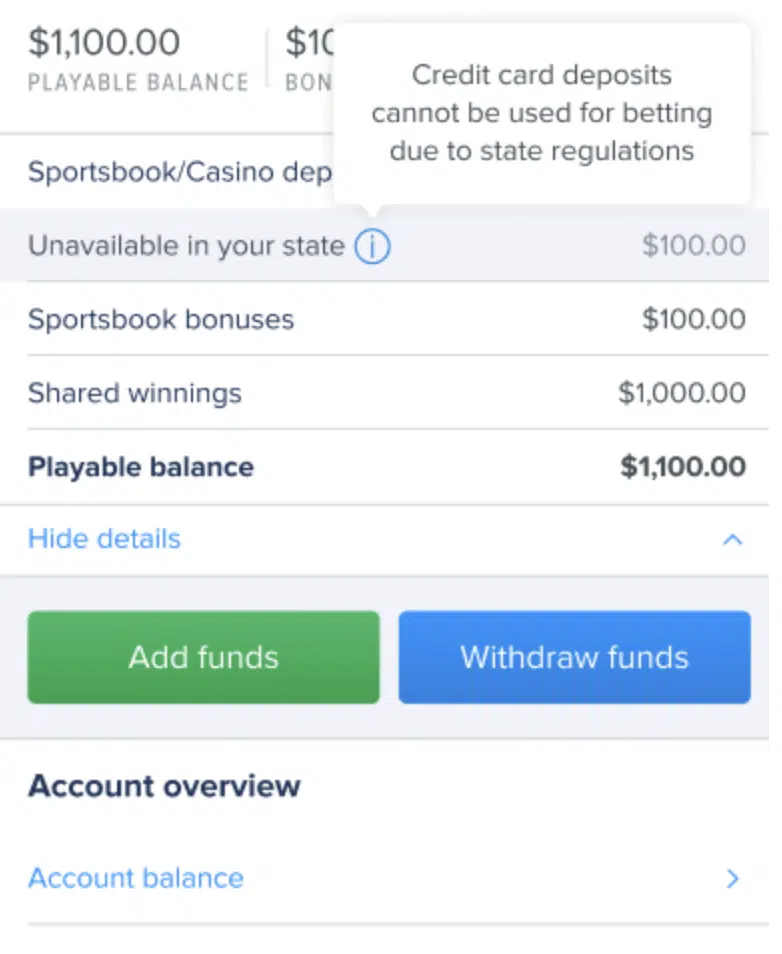
Fans who travel to states that restrict credit card deposits should also note those restrictions still apply even if they deposited while located in a card-friendly state.
For example, a bettor who deposits $100 via credit card while in one state and then travels to Iowa will not be able to use that money to place wagers while they’re in Iowa. In that case, they might see a message like this when accessing the cashier:
Credit Card Brands at US Online Sportsbooks
The major online sportsbooks that still accept credit cards take all brands, but acceptance rates vary broadly outside the most prominent operators.
Visa Betting Sites
Visa has the highest acceptance rate among all credit card brands for depositing funds to online sportsbooks and casinos. Currently, every licensed operator that still takes credit cards accepts Visa, and successful deposit rates are very high.
Some Visa online sportsbooks also support Fast Funds withdrawals (for debit cards only) that can deliver funds to your bank account in under an hour.
Mastercard Betting Sites
Mastercard is just a step down from Visa in terms of availability, with nearly universal acceptance rates. However, few online sportsbooks and casinos support withdrawals back to Mastercard debit cards.
Discover and American Express
Discover and American Express remain relatively uncommon outside the biggest online sportsbook brands that still accept credit cards.
Additionally, online sportsbooks that do still accept Discover or Amex impose state-level restrictions. Even if you do sign up at an online sportsbook that accepts American Express, that doesn’t guarantee it will be an option where you live.
Credit Card Alternatives for Online Sportsbooks
If convenience is your goal, all legal online sportsbooks offer alternative deposit methods that are just as fast and straightforward as credit cards.
However, if your primary motivation is to bet now and pay later, there are zero alternatives. Every state with legal online sports betting prohibits operators from extending credit to customers, and there are no easy workarounds (even PayPal blocks transfers to gambling sites if the funds originate from a credit card).
These are the next-best options for ease of use and speed:
- Debit card: The simplest swap. Debit cards draw from funds already in a checking account, avoid cash advance fees entirely, and are accepted universally among licensed betting sites.
- Online banking: Instant or near-instant at most sportsbooks, no fees on either end, and withdrawals back to the same bank account are standard. ACH is the most common sportsbook withdrawal method for good reason.
- PayPal: Instant deposits and fast withdrawals. PayPal does not share customer banking details with the sportsbook, which is a privacy advantage for bettors who use multiple operators.
- Venmo: Similar to PayPal and owned by the same company. Deposit and withdrawal limits tend to be lower than PayPal.
- Play+ card: A virtual prepaid card/account that supports instant deposits and withdrawals. Users load funds from a linked bank account or debit card. P Play+ account also provides a physical card for ATM cash withdrawals.
- PayNearMe: Lets customers fund accounts with cash at retailers like 7-Eleven, CVS, Walgreens, and Family Dollar. PayNearMe’s primary downside is its low daily limits (usually around $500/day).
- Apple Pay: All prominent online casinos and sportsbooks accept Apple Pay, but you must use a linked debit card. Licensed operators automatically block Apple Pay deposits funded by credit cards.
Problems Depositing with Credit Cards
A declined credit card deposit today is usually due to one of four problems:
- Your sportsbook no longer accepts credit cards: An increasing number of online sportsbooks have stopped accepting credit cards. Even if your betting site accepted credit cards previously, there’s a good chance you ran into a recent policy change.
- Your state has banned credit card deposits: Check the above list to see if your card bans credit card deposits outright. Some states have always prohibited credit cards for online gambling; others have introduced bans more recently.
- Your bank blocks gambling transactions: Some issuers refuse to process any transactions flagged as gambling, whether for legal, fraud risk, or chargeback reasons. Bank of America has historically been more restrictive than most. Call the number on the back of the card and ask whether the issuer permits gambling transactions. If not, the card will not work at any sportsbook.
- Identity verification issues: Federal law requires all licensed betting sites to conduct Know Your Customer (KYC) checks to confirm every user’s age, address, and eligibility. If your online sportsbook cannot fully confirm your identity based on your account information, it may refuse deposits until you upload additional documentation (e.g., pictures of a recent utility bill and photo ID).
Pros and Cons of Betting Online with Credit Cards
The Cash Advance Fee Problem
Most credit card issuers treat online gambling deposits as cash advances rather than standard purchases, which negatively impacts bettors in multiple ways:
- High Fees: Most credit card issuers charge either a flat $10 cash advance fee or 3% to 5% of the transaction amount. For example, a bettor who deposits $20 could pay a $10 fee. That works out to a 50% markup before they’ve placed a single wager.
- Higher Interest Rates:Cash advance APRs typically run 25% to 30%, several points above the standard purchase APR on the same card.
- No Grace Period: Standard credit card purchases have a grace period during which interest does not accrue if the customer pays the balance in full. Cash advances start accruing interest the day of the transaction. Paying off the balance next week does not help.
- No Rewards or Cashback: Cash advance transactions do not earn points, miles, or cashback, even on cards that offer rewards on regular purchases.
For most bettors, that’s four surprises in a row: (1) they get hit with an unexpected fee, (2) pay a higher than anticipated interest rate, (3) don’t get a grace period, and (4) receive none of their standard credit card purchase rewards.
Here’s how the numbers could look if you were to deposit $100 to an online sportsbook using a credit card with a typical cash advance policy:
- Your deposit incurs a $10 fee
- You begin accruing interest at 28% APR that same day
- If you wait a month to pay the balance in full, interest adds roughly another $2.33
In summary, that $100 deposit costs $112.33 before you’ve placed a single wager. The same $100 deposit funded with a debit card or ACH transfer would have cost exactly $100.
There are a few things you can do to avoid surprises:
- Call the number on the back of your credit card and ask how the issuer classifies transactions to online gambling operators.
- Check the cardholder agreement under “cash advance fees” and “cash advance APR.” Those terms are almost always worse than the purchase terms.
- Do not assume past experiences predict future behavior. Even if a card treated prior online sports betting deposits the same as standard purchases, that might not be the case tomorrow. More issuers have trended toward reclassifying online gambling deposits as cash advances than the reverse.
Why Fewer Online Sportsbooks Accept Credit Card Deposits
A combination of regulatory trends, political pressure, and simple economics has pushed numerous sportsbooks to phase out credit card deposits for online betting.
Regulatory Trends: Some states have enacted legislative bans on credit card deposits, either as provisions in the bills that legalized online sports betting or via standalone bills after the fact.
Simultaneously, model legislation from the National Council of Legislators from Gaming States excludes credit card gambling deposits entirely. Lawmakers have shown an increasing appetite for prohibiting sportsbooks and online casinos from accepting credit card deposits over responsible gambling concerns.
Similarly, in states that prohibit using credit cards to fund online gambling transactions, gambling regulators have come down heavily on operators that violate the ban. In 2025, the Massachusetts Gaming Commission fined DraftKings $450,000 for accepting credit card deposits erroneously.
Political Pressure: In February 2026, Senator Elizabeth Warren sent letters to 11 online sportsbook operators asking about their policies on credit card deposits, which often come with cash advance fees when using to fund online gambling accounts.
Warren’s letters put a spotlight on credit card cash advance fees, which she specifically called “junk fees.” The letters also stated that bettors are often “unaware of the costs and fees associated with this type of credit card use, which can push them into financial trouble when gambling.”
FanDuel announced its ban on credit card deposits less than a week later. Senator Warren later called on other online sportsbook operators to follow suit.
Simple Economics: Credit card deposits tend to produce higher chargeback rates than debit or ACH, and each chargeback costs operators nearly $100 on average.
Flutter Entertainment, FanDuel’s parent company, and DraftKings have both told investors that the revenue impact of removing credit cards is minimal. That likely means operators have found that the costs of accepting credit cards outweigh the benefits.
Credit Card Betting FAQ

Mike Murphy is the founder of BettingUSA.com and has over 10 years of experience in the legal gambling industry. A regular attendee of industry trade shows and conferences, Mike is a strong proponent in the idea of a well regulated online betting industry.